Harvey Barnes, Space, and the System: Why the Right Partners Could Unlock His Best Scoring Season Yet
When Harvey Barnes departed Leicester City in the summer of 2023, he did so as one of the few players to emerge from their relegation season with reputation intact. Thirteen Premier League goals in a struggling side is a quietly elite return, roughly one every 200 minutes in open play, and the majority scored from intelligent diagonal runs into space that Leicester rarely created in abundance.
Barnes’s game has always depended on movement and timing more than volume or chaos. He is not a winger in the classical sense, not a dribbler who weaves through tight spaces or an inverted forward who dominates possession phases. He thrives when others make space for him to attack, when midfielders find him early in transition, and when he can run onto the final ball rather than receive it with his back to goal.
That distinction, and how his teammates use him, could be what determines whether Barnes can replicate or even better that 2022-23 season.
And that’s why the conversation about his supporting cast, Woltemade and Ramsey, rather than Isak and Joelinton, matters.
The Barnes Blueprint
To understand Barnes, you have to watch how he scores. In the 2022–23 season, almost every one of his 13 goals came from the same pattern:
Leicester recover possession and play quickly through midfield, often via James Maddison or Youri Tielemans. Barnes drifts inside from the left, holding his run on the shoulder of the full-back. A teammate slides a vertical pass or executes a quick one-two, allowing Barnes to explode through the half-space and finish early.
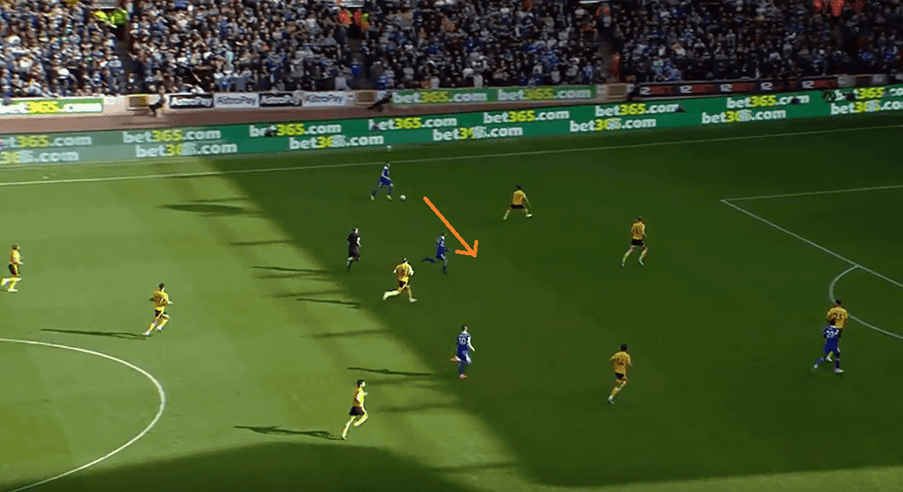
The goal versus Wolves in October 2022 is the perfect encapsulation:
Barnes receives the ball on the left and side, and plays the ball centrally to Maddison.
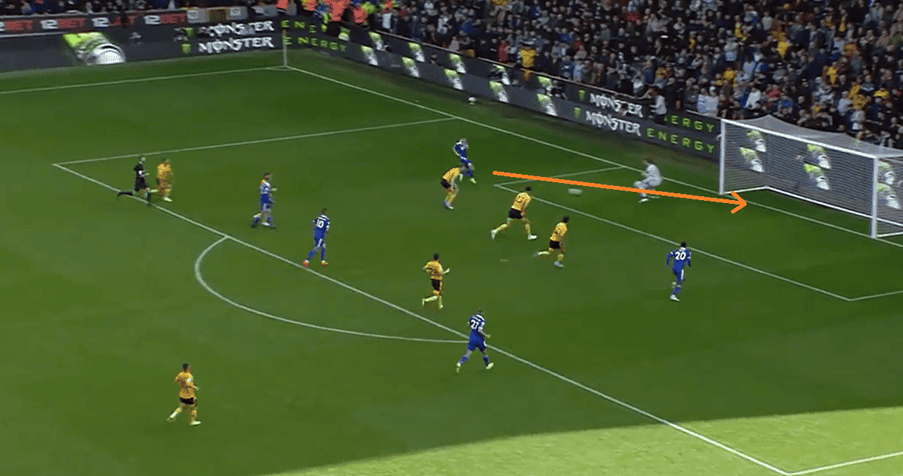
Maddison waits for the channel to open, and releases Barnes just as the full-back steps out to engage him.
One touch, one stride, finish under the keeper. That movement is Barnes distilled.
In tactical language, he is an attacking transition specialist. But in practical terms, he’s the player who turns a good turnover into a goal within three passes.
A Question of Chemistry
When Barnes arrived at Newcastle, his role shifted. Playing with Alexander Isak and Joelinton, both of whom prefer to receive feet-to-feet rather than play on the turn, he often found himself receiving too late.
Isak, elegant and clinical, likes to operate in narrow zones, drifting left himself to combine or dribble inside. Joelinton, for all his physicality and pressing intelligence, tends to occupy that same half-space and hold onto the ball to draw fouls or recycle possession. The result: Barnes’s best runs were either blocked by teammates or ignored in favour of patient buildup.
At Leicester, Maddison’s instinct was to play him early. At Newcastle, the attacking structure often delays that vertical pass, particularly as teams often play deeper against Newcastle as they know the threat they offer in transition. When Isak dropped, he did so to dictate, not to bounce passes into the wingers; when Joelinton receives, he shields rather than releases. For a player like Barnes, who thrives on timing and forward momentum, that half-second of hesitation is the difference between a through-ball and a turnover.
There were of course moments when it has worked for Barnes, when he was found early.
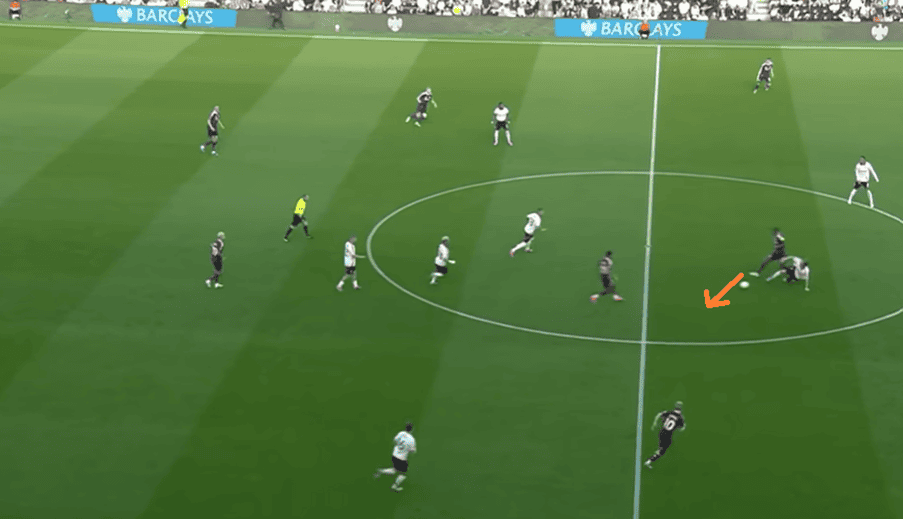
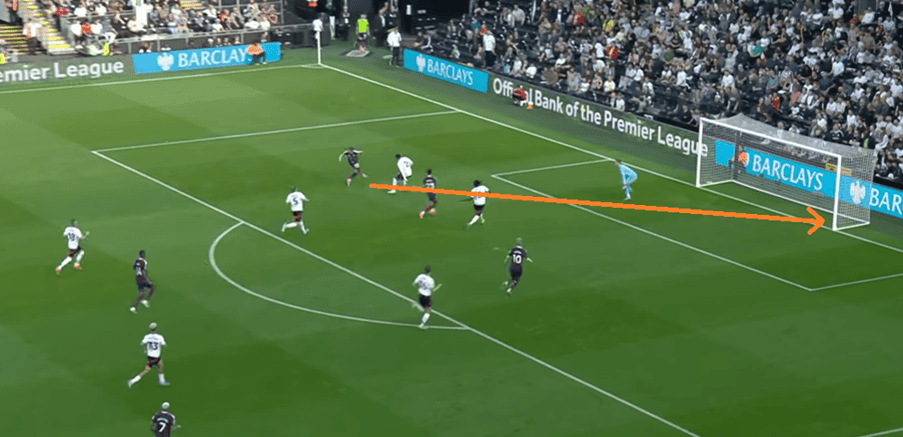
Against Fulham in September 2024, we saw a classic Barnes goal. In this instance Isak dropped deep and played a one-touch layoff into Murphy.
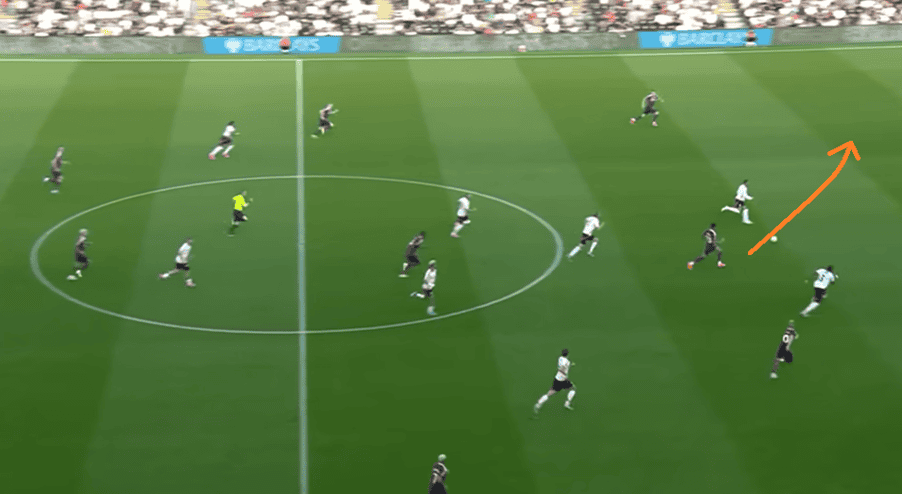
Murphy drives into that Isak’s movement has opened up, with Barnes sprinting forward into the open grass that has been left for him. Murphy plays a well timed pass right into his path.
Barnes takes a touch into the box, getting himself a yard of space to get his shot off, burying it int the far corner. The classic Harvey Barnes goal.
Learning to Play With Barnes
Part of the challenge lies not just in Barnes adapting to the team, but in the team learning to play with Barnes.
Newcastle’s left flank revolves around Anthony Gordon, whose instincts are almost the inverse of Barnes’s. Gordon is a conventional winger: he wants the ball early, wide, and to feet. He thrives in isolation, squaring up his full-back and driving inside or outside with pace. At his best, when he receives the ball, the play tends to slow momentarily, inviting the defender into a duel he usually wins through agility and persistence.
Barnes, by contrast, doesn’t want that duel at all. He wants the defender to think the duel is coming, then time his run into the space that opens when the full-back hesitates. He doesn’t seek to beat his man, he seeks to escape him.
For Newcastle’s midfielders and full-backs, that represents a mental adjustment. Where Gordon calls for the ball to feet, Barnes needs them to resist that temptation, to delay the pass until he’s already moving. That subtle difference changes the rhythm of a possession sequence. It requires a kind of collective anticipation: a team that understands when to look for the runner, not the receiver.
At Leicester, Barnes had that understanding almost instinctively with Maddison and Tielemans. At Newcastle, he’s yet to find that consistently.
Enter Woltemade and Ramsey
Which is why the idea of Barnes linking with Woltemade and Jacob Ramsey feels tantalising.
Woltemade, the young German forward, plays a deeper connective role, something between a false nine and a link striker. His first instinct when dropping into midfield is to draw a defender out and release the runner behind him. At Werder Bremen, he often played wall passes with wide forwards or No.10s making diagonal runs, precisely the kind of rhythm Barnes thrived on at Leicester.
Ramsey, meanwhile, is not as ponderous in the ball as Joelinton. His value comes in quick, vertical combinations and those one-touch, bounce passes that turn pressure into opportunity.
Together, Woltemade and Ramsey could give Barnes exactly what he needs: a structure that releases him into space rather than forces him to create it.
The Case for Early Release
When Leicester managed to find Barnes early, the numbers followed. In games where he received three or more progressive passes into the box, his xG per 90 nearly doubled (0.39 to 0.72). Across the 2022–23 season, his conversion rate on first-time finishes was 28%, compared to just 12% when taking two or more touches.
That suggests a simple pattern: the earlier the ball comes, the more dangerous Barnes becomes.
Compare that with Newcastle’s 2023–24 season, when Barnes featured before injury, his progressive receptions fell by almost 25%, and his average touch location shifted five yards wider and deeper. The tactical framework, high-possession, structured buildup, dulled the weapon that had defined him.
A partnership with Woltemade and Ramsey offers the opposite: fluid movement, positional rotation, and rapid vertical exchange. Both players are natural accelerators of play, not holders of it.
The Tactical Picture
If Barnes operates off Woltemade, you can imagine a pattern where Woltemade drops into a midfield position, drags a centre-back out, and plays a short layoff into Ramsey or the advancing midfielder. Barnes, already on the move, darts inside the channel that Woltemade has opened.
One touch, through ball, shot. It’s a repeatable mechanism, and repetition is what turns moments into systems.
The Verdict
Barnes doesn’t need more touches or a higher usage rate. He needs a team that reads his runs and gives him the ball early enough to do something with it.
Playing with Isak and Joelinton, for all their qualities, often narrowed his world, forcing him into secondary runs, later actions, and crowded spaces.
Playing with Woltemade and Ramsey could expand it. Their natural tendencies, drop, connect, release, mirror the conditions that made Barnes a consistent scorer in a faltering Leicester side. If they can replicate those rhythms in a new system, Barnes’s goal tally could climb past the 13 that once felt his ceiling.
And for a player who’s made a career out of timing his runs perfectly, maybe now is the time his teammates finally time the pass to match.