

After back-to-back strong finishes, seventh in 2023/24 and fifth in 2024/25, Newcastle United’s opening to the 2025/26 season has felt strangely muted. Ten games in, they sit 13th. The table is tight and the sample is small, but the story so far is clear enough: even as the defence has quietly improved year on year, the attack has regressed sharply. The numbers don’t just point to worse finishing; they paint a broader picture of a team producing fewer and lower-quality opportunities, and doing less to unsettle opponents in the ways that once defined them.
Where the goals went
The top-line is stark. Newcastle have slid from 2.2 goals per game in 2023/24 to 1.8 in 2024/25 and now just 1.0 per game in 2025/26. That kind of step-down is rarely explained by a single factor, but it frames everything else: the team simply isn’t putting the ball in the net often enough.
Some will place that squarely at the door of Alexander Isak’s departure to Liverpool in the summer. Losing a top-end striker will dent any attack, but the broader pattern suggests the root cause goes beyond the identity of the No 9. Newcastle aren’t just finishing less; they’re creating less.
Fewer big chances, fewer ways to hurt you
Newcastle’s big-chance production has faded from 3.5 per game in 2023/24 to 2.8 in 2024/25 and now down to 1.9 per game in 2025/26. When the pipeline thins like that, the margin for error in front of goal shrinks with it. The club’s best attacking spells under Eddie Howe were defined by volume and pressure, repeat entries, aggressive second-ball wins, early crosses after regains, and quick combinations around the box. A lower drumbeat of entries naturally reduces those chaotic, high-value moments that once arrived in waves. It wasn’t a team defined by surgical precision with a scalpel, it was a more a wrecking ball to the face of the opposition.
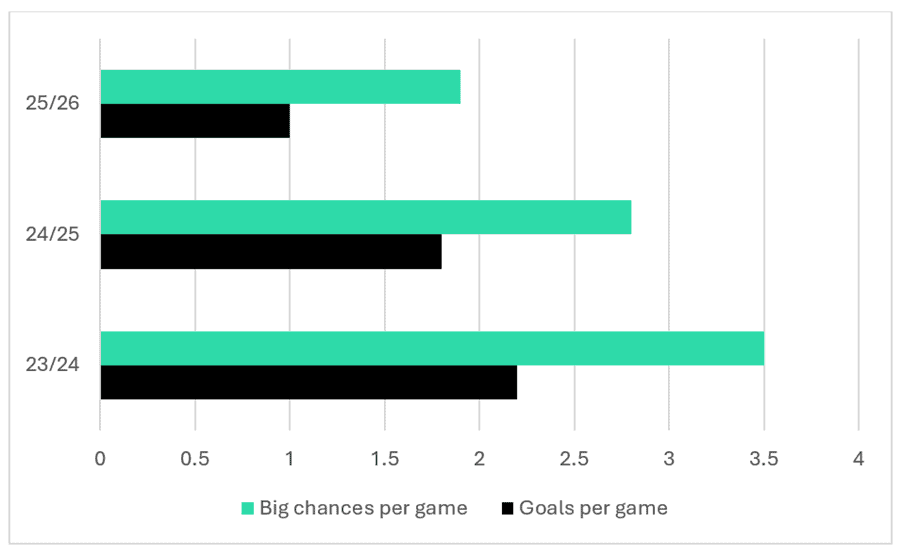
Image: Graph showing big chances and goals per game for the previous three seasons.
The mechanical impact shows up everywhere. There are fewer cutbacks, fewer third-man breaks, and fewer scruffy finishes from sustained pressure. It is not that the team has forgotten how to score; it’s that they are spending less time in the exact game states where they used to feel inevitable.
Finishing isn’t the only culprit — but it’s not spotless either
There is a finishing story here, just not the obvious one. In the wake of Isak’s exit, the question was whether the replacement could convert. On that score, Nick Woltemade has pulled his weight, marginally overperforming his expected goals by 0.05, essentially finishing at or slightly above par. The shortfall, then, is collective. Others aren’t burying the chances they do get, and because there are fewer of those chances overall, the missed ones stand out more. When the tap only drips, every drop matters.
This is the uncomfortable middle: it’s harder to generate quality shots, and the ones created are being taken by a group that, beyond the centre-forward, is running a little cold. The outcome is a team that can look tidy for long stretches but struggles to produce the specific moments that decide games.
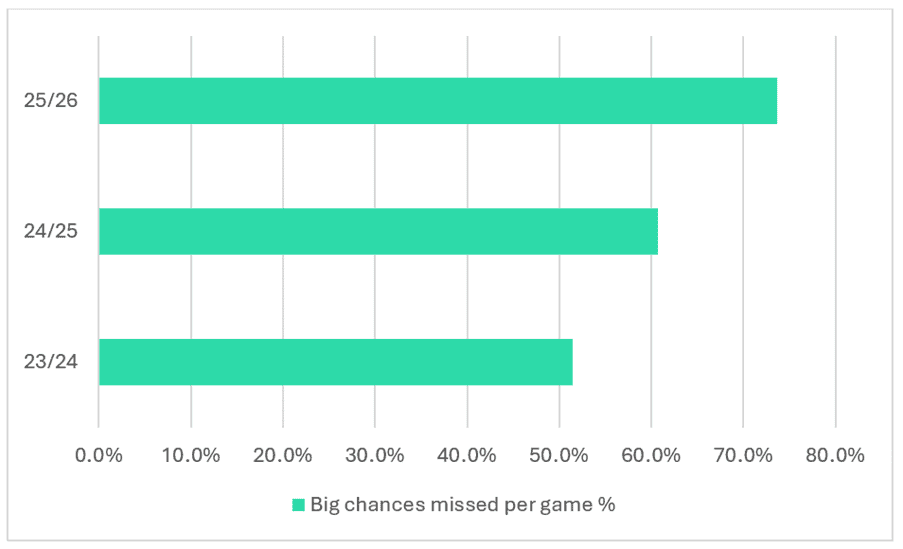
Image: Graph showing the percentage of big chances missed for the previous three seasons.
Shot selection and the vanishing threat from range
One of the more curious developments in Newcastle’s attacking profile this season is the uptick in shots from outside the box. After a gradual decline over the past two campaigns — 4.1 per game in 2023/24, then 3.9 in 2024/25 — the number has jumped to 5.0 per game in 2025/26. On the surface, that might suggest a more ambitious approach, but the context tells a different story.
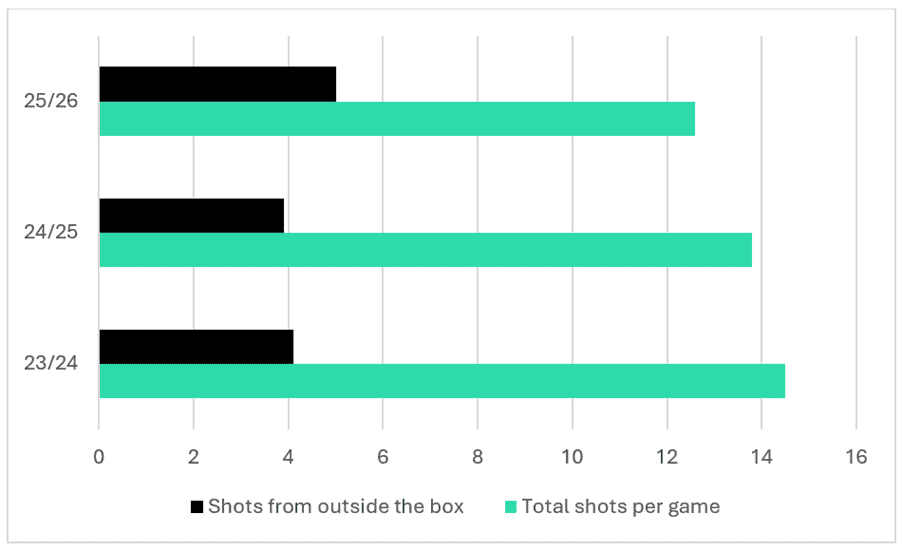
Image: Graph showing the total number of shots and the number of shots outside of the box per game for the previous three seasons.
The increase isn’t driven by a tactical shift toward long-range shooting; it’s a symptom of a deeper issue. With big-chance creation down significantly, Newcastle are simply finding it harder to work the ball into high-value areas. As a result, more attacks end with speculative efforts from distance, not because they’re preferred, but because they’re available.
Interestingly, the goals from outside the box have held steady at 0.2 per game, consistent with previous seasons. That suggests the quality of those efforts has dropped, but the reliance on them has increased. It’s a subtle but important shift: Newcastle are leaning more heavily on a tool that was once supplementary, not central.
This change makes the team more predictable. Opponents can sit deeper, knowing that Newcastle are less likely to break them down through intricate play or overloads in the box. The long-range threat remains, but without the chaos and variety that once surrounded it, it’s easier to manage. For a side that used to thrive on unpredictability and pressure, this new shape feels flatter — more controlled, but less dangerous.
The good news: a quieter, sturdier defence
This is not a crisis without positives. Goals conceded have trended down each season: 1.6 per game in 2023/24, 1.2 in 2024/25, and 1.1 so far in 2025/26. That matters. If you can keep games on a lower scoring axis, you reduce the number of goals required to win. It’s a foundation worth protecting, and a reason why the pathway back to form may be shorter than it feels. Stabilising at the back is often the hard part; reigniting the attack, with the right tweaks, can come quickly.
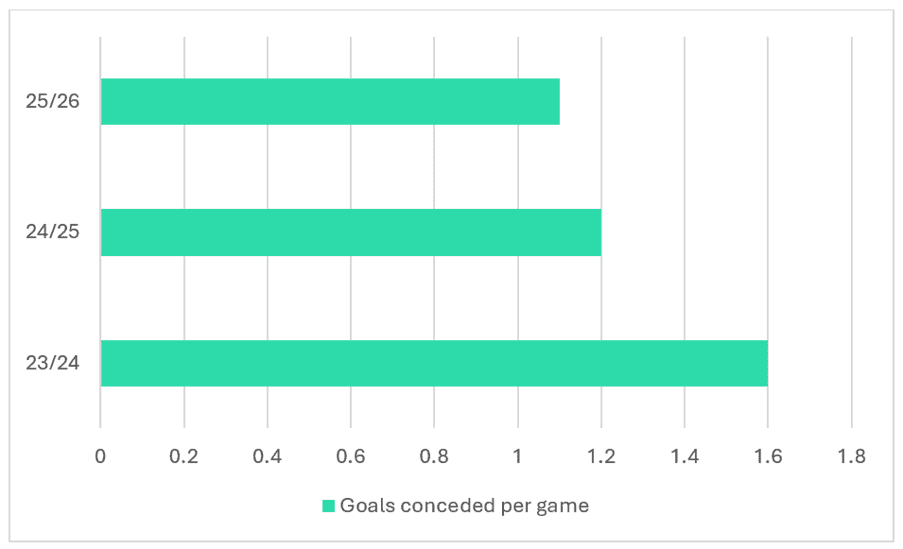
Image: Graph showing the number of goals conceded per game for the previous three seasons.
The tactical recalibration: control versus edge
The numbers suggest a team trying to move towards greater in-possession control — more method, fewer flips of the coin — and paying an attacking tax for it. Control is valuable, but when it sands off too much of the team’s disruptive edge, the whole becomes less than the sum of its parts. Newcastle at their best under Howe mixed structure with aggression: they pinned teams in, created turnovers high, and embraced the messy spells where their athletes, runners and crowd could take over. The current balance looks tipped a little too far towards patience without the counterweight of pressure.
Injuries have amplified the issue. Without Lewis Hall and Tino Livramento, Newcastle have been missing two of their best ball carriers and line-breakers from deep. Those players don’t just add final-third threat; they are the elevator that lifts the team out of the first press. In their absence, more minutes fall to Dan Burn and Kieran Trippier. Both remain high-level contributors in their own ways, but neither can consistently carry the ball through pressure the way they once did. That means fewer fast exits, fewer early crosses on the run, and fewer situations where the opposition’s shape is scrambled.
When your build-up is a touch slower and your full-backs are less inclined to carry into space, wingers receive to feet more often than on the move and midfielders face more set defensive blocks. Over time, that chips away at both big-chance creation and the appetite to shoot from range.
The transfer window and rhythm
It also matters that the summer’s centre-forward transition came late. Losing a key striker and bedding in replacements as the season begins is rarely seamless. That costs you automatisms: the half-second triggers between wide players and the No 9, the timing of near-post darts versus cut-backs, the shared picture of when to quicken or slow possession. These are small misunderstandings that only show up as vanished chances, a fraction too early on the cross, a fraction too late on the through-ball, but stack them across a month and they explain a chunk of the attacking dip.
What can change quickly
The road back isn’t complicated, and it doesn’t require a philosophical U-turn. Three levers are available right away. First, increase the pressing aggression in select game states, even five- or ten-minute bursts each half can produce the repeat entries that swell big-chance numbers. Second, be brave on the ball, whether shooting from range or playing that killer pass, don’t hesitate to wait for the ideal moment, just do it. Third, accelerate the ball-carrying out of the first line; when Hall and Livramento return, that should come naturally, but in the meantime, scripted rotations to free a midfielder to carry through the inside channels can replicate the effect.
Layering those tweaks onto a defence already trending in the right direction can turn 1-1s into 2-1s and 0-0s into 1-0s. The margins are thin; that’s the point.
The bottom line
The balance is off. Some of that is the aftershock of losing a leading striker and finding the new rhythms late in the window. Some of it is a deliberate move toward control that has dulled the chaos Newcastle once weaponised. Some of it is injuries.
And yet, this doesn’t feel terminal. The table is congested. Newcastle have shown before that once the attack re-lights, they can string results together, five in a row, then six in a row last season, and surge up the league. Howe has navigated rough patches and found solutions. He can do it again. A handful of recalibrations, a little more front-foot pressing, a little more intensity into their game, a little more verticality in build-up, could be enough to turn a slow start into a platform.
For now, the picture is of a side a couple of small steps from themselves. Get those steps right, and the climb back won’t take long.