Anthony Gordon: From Irresistible to Enigmatic — and What Eddie Howe’s Comments Might Tell Us
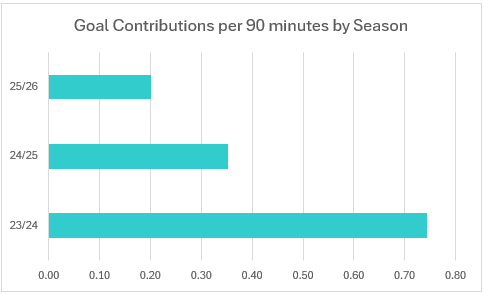
On spring nights in 2024, Anthony Gordon felt inevitable. He played with that shoulder-dropping menace St James’ Park loves: driving at full-backs, darting inside centre-backs, slipping passes across the six-yard box like he owned those inches of grass. In the Premier League alone that 2023/24 campaign brought a blend of goals and assists that made him Newcastle’s most reliable forward threat, with 26 goal contributions in 35 games. He was a force that season, regularly beating his man, causing panic in defences and producing a steady stream of decisive actions. It looked like Gordon had cracked the code — the blueprint for sustained success was right there in front of him.
The Abrupt Fade
Instead, the output dipped. In 2024/25, Gordon’s Premier League return fell to just 12 goal contributions in 34 games, a halving of his headline productivity year-over-year. And in the current 2025/26 campaign, with 15 league matches played, he sits at only three goal contributions. The contrast is difficult to ignore: the player who once looked like Newcastle’s surest wide threat has become, domestically, a study in sputter.
Form can be the most fragile currency in football, and there are always explanations offered in hindsight. But the numbers tell a story of a player struggling to rediscover his spark.
Image: graph showing Anthony Gordon’s goal contributions per 90 for the last three premier league seasons.
What Changed? The Summer That Lingered
One theory has long hovered: the Liverpool links. In the financial squeeze in the summer of 2024, Newcastle navigated Profitability & Sustainability pressures and, for a time, Gordon to Liverpool became a live rumour line. Prices near £80–100 million were floated, and multiple outlets reported that the winger, a lifelong Liverpool supporter, would have been open to the move if the dominoes fell.
The dominoes didn’t. Newcastle found other sales that alleviated the immediate squeeze and kept Gordon where he was. Even so, the swirl of speculation may have chipped away at focus and enjoyment. Transfers don’t have to happen to leave a mark. The almost can be just as destabilising.
A Costly Flashpoint
Then came March 2025 and a moment that carried real consequences: the red card at Brighton for a reckless shove that ruled Gordon out of the Carabao Cup final Newcastle went on to win, the club’s first domestic trophy in seven decades. Howe praised Gordon’s attitude in the aftermath, but the absence was unavoidable and symbolic: the player destined to be central to the story wasn’t on the pitch when history was made.
Moments like that shape narratives as much as they shape seasons.
The Left-Wing Conundrum — and Howe’s Revealing Answer
Layer onto that the positional puzzle. Newcastle now have two left wingers who want the same real estate: Gordon and Harvey Barnes. Barnes has at times operated off the right to accommodate Gordon’s preference for the left, and that choice has frequently irritated supporters who see Barnes’ most effective work coming from the flank he grew up on. Gordon, by contrast, has often kept his preferred side even when his form has dipped.
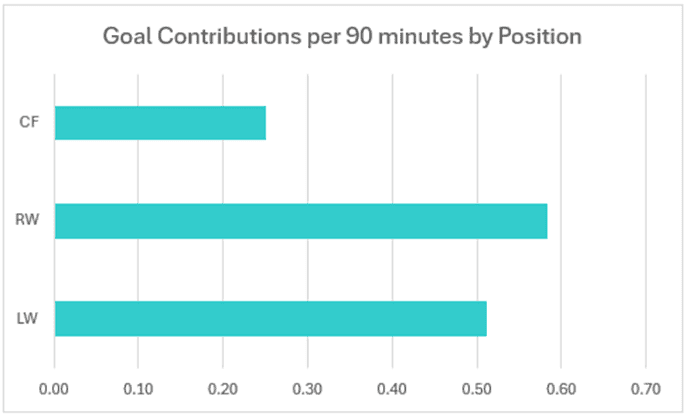
Whilst Gordon may have a preference for the left side, his goal contributions for Newcastle United in either position are very similar when comparing them per minutes played. Whilst they are similar, Gordon is more involved in assists that goals when playing from the right, but ultimately the benefit to the team remains consistent.
Image: graph showing Anthony’s Gordon’s goal contributions per 90 for each position played.
Normally, Howe keeps internal preferences private. But this week, in an answer that felt more candid than his usual press-room rhythms, he admitted the underlying dynamic:
“I don’t think Anthony enjoys the right, but Harvey is more open to it and enjoys the freedom there. That’s why. It doesn’t mean I can’t, but if a player doesn’t want to play there you can’t really force them to as you won’t get the same level of performances.”
For a manager renowned for controlled media lines, those words landed. Not because they were incendiary, but because they hinted at the trade-offs being made: maximise Gordon’s comfort zone on the left, even if that means sub-optimising Barnes; avoid a spot he “doesn’t enjoy” for a player whose form already needs coaxing back.
Fans have noticed. Some hear that quote and think: isn’t the team’s balance the priority? Others counter: if you believe Gordon can be rekindled, you keep him where he is strongest. What irritates some supporters, though, is the contradiction. Gordon has shown a willingness to cover as a central striker when injuries bite, despite his performances there being largely ineffective and the positional shift far more drastic than moving from left wing to right. If he can accept that change, why not the smaller adjustment for the good of the team? There isn’t a frictionless answer, but there is a question about edge — the hard managerial edge required to push players into less comfortable roles for the collective.
Is Attitude a Factor, or Are We Misreading Preference as Resistance?
It’s easy to map preference to personality. Does Gordon’s reluctance to play right reflect a self-first streak that bleeds into performance? Or is it the perfectly normal bias of a modern inverted winger, the same sort of preference you’d find in countless top attackers who sharpen their angles off a favoured side? Howe’s phrasing matters: he didn’t say Gordon refuses; he said Gordon doesn’t enjoy it, and that he weighs the performance impact of forcing that switch.
There’s also the tactical layer. Gordon’s best unchecked work is left-to-right diagonal: carry from touchline, attack half-spaces, slip the back-post runner, or drill low across the six. On the right, those patterns flip; his off-the-ball movements and combinations change; his decision tree is different. If a player is already light on confidence, asking him to rewrite his muscle memory mid-run can be an unnecessary complication.
So Why Has the Form Dropped?
Put it all together and you get a cocktail of plausible drivers: transfer turbulence and identity, a narrative weight from the cup final absence, role continuity that prioritises comfort over flexibility, and confidence loops that feed on themselves. None of this says Gordon isn’t still a difference-maker, look at the Champions League group stage, where his output is higher and his directness looked closer to vintage. It says the domestic rhythm is out, and the fixes aren’t simple.
The Open Question
Which brings us to the heart of it — one a lot of Newcastle fans are quietly asking themselves after Howe’s comments:
Given Gordon’s sustained drop-off in league form, and his reluctance to play on the right, is his attitude part of the reason for the dip — and is Howe’s handling of the situation, favouring preference over positional needs, a sign he’s not being firm enough to extract top-level standards from a top-level talent?
It’s not a verdict. It’s the tension between individual optimisation and collective demands, between trusting a player’s best lane and insisting he drive a different one when the team requires it.