Anthony Elanga’s Newcastle Conundrum: Why His Forest Form Hasn’t Followed Him to St James’ Park
When Newcastle United paid £55 million to sign Anthony Elanga from Nottingham Forest in the summer of 2025, the logic was straightforward. Eddie Howe needed a top quality right‑wing option, someone who could both stretch teams and add end product, an upgrade on the diligent and much‑improved Jacob Murphy. The expectation was an instant impact, or a near instant impact.
So far, that hasn’t happened.
This isn’t to put a line through Elanga’s prospects on Tyneside. He has, after all, played just 14 games for the club so far, some of those from the bench, which makes any definitive verdict premature. But the contrast between the player Forest unleashed in transition and the version seen at St James’ Park is stark enough to explore the “why” behind the “what”.
Below, we dig into the early data, the tactical context, and what has (and hasn’t) translated in Elanga’s game.
The headline numbers: from output to outage
In two seasons at Nottingham Forest, Elanga contributed 31 goals and assists combined. That equated to 0.57 goal contributions per 90, a strong return for a wide forward in a counter-attacking side. For Newcastle, in his nine league appearances, he has 0 goal contributions so far.
The same pattern shows up in his creativity metrics. His goal‑creating actions (a measure that includes assists and the pass prior to the assist) have gone from 0.59 per 90 at Forest to 0 at Newcastle. As simple as those figures are, they’re also important, and they frame the question we need to answer: is this a blip based on a small sample, or the symptom of a deeper stylistic misfit?
We’ll move beyond the headline figures, but they set the stage.
Why the change? Different teams, different problems to solve
The most compelling explanation is context. Newcastle and Nottingham Forest ask their wingers to solve very different problems.
Forest played much of their football on the back foot, committed to a compact low block, then springing quick counters into open grass. Elanga’s speed made him a first‑choice outlet: receive on the move, attack the full-back one-v-one, and drive into the space left by an opponent pushing on.
Newcastle, under Eddie Howe, are much more front foot. They press aggressively, dominate possession more often, and spend longer phases camped in the opposition half. In that environment, the winger’s job isn’t simply to sprint into green grass; it’s to dislodge set defences: combine, rotate, receive under pressure with back to goal, and execute in tighter spaces.
In other words, the pitch feels bigger at Forest and smaller at Newcastle.
Touch profile: more of the ball, but in busier places
Elanga is actually seeing more of the ball at Newcastle: 47 touches per 90 versus 39 at Forest. The difference is where.
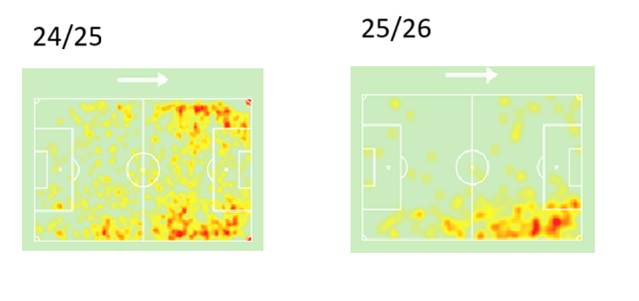
At Forest, he’d frequently receive deeper, often in the middle third, to launch counters. The touch map was fluid between both flanks as he moved to find space or isolate a weak defender.
At Newcastle, he’s seeing more touches in the final third and inside the box, and they’re concentrated down the right. That role asks him to combine in tight triangles to manipulate well organised defences. It’s a different skill set from accelerating past a full‑back with 30–40 yards to attack.
This shift shows up in his take‑on profile. His attempts per 90 are similar, 2.99 at Forest, 3.02 at Newcastle, but his success rate has halved, down to 15% from 33%. That’s the price of dribbling in traffic. When the defending team is set, the angles shrink, cover is closer, and the margin for error tightens. Elanga’s best attribute, raw pace, is harder to weaponise when there’s no runway.
Image: Anthony Elanga heatmap for the 24/25 and 25/26 season.
The Barcelona example: a glimpse of the fit when the game opens up
One data point doesn’t make a trend, but it illustrates the broader point. Against Barcelona in the Champions League, Elanga looked extremely effective. Barça’s high line, combined with their dominance of possession, invited Newcastle to counter more often, gave him exactly the canvas he prefers: one-v-one against his full-back, with 40 yards of grass behind to attack.
In those moments, Elanga looked every inch the £55m signing: decisive, direct, and devastating in the open field. When Newcastle’s matches take that shape, he naturally looks closer to his Forest self.
What Eddie Howe is asking for on the right
Under Howe, the right-sided winger is expected to be more than a runner. The template includes pressing intelligence to lock the ball on the far side, underlapping and overlapping coordination with the right-back (often Trippier or Livramento), and third-man patterns with the right-sided No 8 (Bruno), it all gets very intricate at times. But equally there are moments that require raw pace and early delivery into the forward, an area where Elanga has shone when given the chance, even if the finishing of the forwards has denied him that mark in the assist column.
Elanga has shown he can meet the work-rate and pressing requirements, Howe rarely selects wide players who don’t. Where the adaptation is still bedding in is the craft: receiving with a defender tight, shielding and rolling into space, finding the disguised pass instead sprinting into open space.
Is Elanga “big‑team” adaptable?
This is the crux. Being a top‑five league winger in a transition-heavy side and being a top winger for a dominant team are related but not identical jobs. The former prioritises pace and decision speed; the latter prioritises craft, deception, and repeatability against set blocks.
Elanga has the athletic baseline and enough technical foundation to add layers. Eddie Howe’s track record improving players, tightening first touches, sharpening body shape, refining pressing triggers, is encouraging. The question is how quickly Elanga layers on those possession skills: receiving at angles, playing around corners, and threatening inside as often as outside.
If he gets there, his speed turns from a blunt instrument into a finishing move, used at the moment defences are destabilised, not to try to destabilise them single‑handedly.
It’s also relevant that Jacob Murphy remains a very good player, fluent in Newcastle’s approach. His presence means there is no pressure on Elanga to force it every week. That can be helpful as it allows Elanga time to settle in.
The verdict (for now)
The fee and the role, primary right winger and expected upgrade on Murphy, naturally inflate expectations. The output drop is stark but sits on a small sample size.
Until he settles, doubts are inevitable. Elanga is a good player; whether he proves to be the right signing for Newcastle United depends on something simple but not easy: adapting his strengths to smaller spaces. If he can do that, the zeroes in the early columns will feel like a footnote. If not, this will go down as a talented runner who never quite fit the game Newcastle spend most weeks trying to play.
Either way, we’ll learn a lot more once the sample grows, and once Newcastle find more games that oscillate between control and chaos, giving Elanga both the structure to combine and the runway to fly.