
Welcome to the first edition of Play By Numbers — our regular deep dive into the stats behind Newcastle United’s recent performances. The aim is simple: use data to confirm what you’ve been watching with your own eyes, and sometimes to uncover a hidden detail or two. This isn’t here to replace your judgement; it’s here to sharpen it. We’ll track trends and patterns, explain new terms in plain language, and hopefully shed some light on the reasons behind the results.
This piece will look into the expected goals (xG) and how Newcastle are shaping up this season. It’s a commonly used term but for those who are less familiar, xG estimates the quality of a chance by assigning a probability that a shot will become a goal. A one on one might be 0.40 xG (40% chance), a speculative 30 yarder might be 0.02 xG (2%). Add those probabilities up and you get a game’s or team’s xG total. It’s a way of asking, “Given the shots we took, how many goals would an average team score?” With football being a low scoring sport, it’s not an overly useful metric for a single game as there is too much opportunity for variance. The longer the time period the data covers, the more useful it is.
Goals scored vs xG: are Newcastle underperforming?
Through eight league matches, the data says yes. Newcastle’s chance quality adds up to 10.85 xG, but we’ve only scored 7 league goals — an underperformance of–3.85 goals so far.
To put that in context across the league, only two Premier League teams are worse at finishing their chances relative to the chances they’ve created: Manchester United (11 goals from 15.51 xG,) and Crystal Palace (12 goals from 19.10 xG). The major difference here though is the value of xG for those to sides. Yes they are less clinical than Newcastle, but they are creating a lot more so the effect is felt less, which shows in that both of these clubs have scored more and accrued more points so far this campaign.
What we will say is that we are only eight games in. Early numbers can swing with one clinical afternoon or one off day in front of goal. Treat these as early signs, not final verdicts.
Who’s responsible for the finishing gap?
If the team is under the xG line, the next question is who is above and who is below it. Newcastle have three players who are outperforming their xG this season:
Bruno Guimarães — 2 league goals from 0.72 xG. That’s a huge overperformance but again a small sample size.
Nick Woltemade — 4 goals from 3.24 xG. A modest overperformance, but the bigger point is he’s consistently getting on the end of decent chances when new to the team.
William Osula — 1 goal from 0.54 xG in limited minutes; again, slightly ahead of expectation.
The rest of the team are below their xG, although again it’s from a limited number of games and not a huge variance for most. The two who stand out though are:
Anthony Gordon — 0 goals from 1.85 xG. He’s getting into scoring spots; the finish hasn’t arrived yet.
Jacob Murphy — 0 goals from 1.32 xG. Similar story: the positions are decent; the payoff is missing.
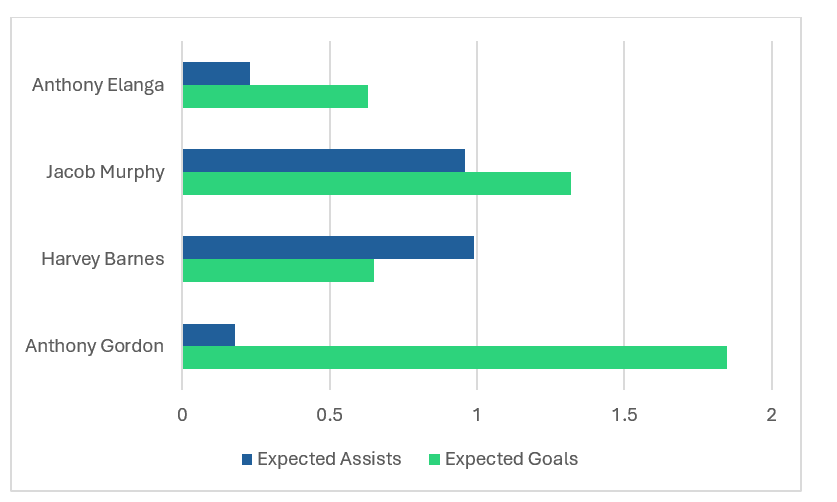
Image: Expected goals and assists for Newcastle’s wingers this season.
Underperforming against their xG isn’t the only issue. Newcastle have other forwards who are not getting the opportunity by either not being in the right position to get a shot off or being a little shot-shy. Both Harvey Barnes and Anthony Elanga have a relatively low xG, 0.61 and 0.63 respectively. They have played less minutes than Gordon and Murphy, but even with that taken into account, they are down. It doesn’t matter if you under or overperform xG if you’re not generating much xG in the first place. Being wasteful (underperforming xG) isn’t the same as being toothless (low xG to begin with). Newcastle are both under finishing and not creating top tier volume yet.
Newcastle’s attack sits around mid table for chance creation, 10th in the league for xG. That’s not disastrous, but it isn’t the top six tempo we want. It’s also consistent with the feel of games: tidy phases, not enough repeated penalty box pressure and being afraid to shoot.
The tactical question: how to create threat without both attacking full-backs?
This is the heart of Eddie Howe’s current puzzle. When Newcastle’s full-backs dominate the touchline, think Hall and Livramento at their best, we stretch teams horizontally and get those opportunities to cut the ball back into dangerous areas. With injuries/absences limiting that edge, Newcastle have too often defaulted to lofted balls, asking Woltemade to turn aerial scraps into goals. That’s not a strategy for long term success.
Continuing to play with a back four, utilising Burn as a left back isn’t an option. Burn’s last spell at left back saw him unceremoniously dropped from the team, with his reputation entirely rehabilitated as a commanding centre-back. So what could Howe do?
Use Trippier as an “inside full back” to create midfield overloads. Trippier’s delivery is top quality, even if not longer what it was, but hugging the touchline and overlapping the winger ahead of him isn’t his game anymore. Stepping inside at times (think an extra No.6 in build up) would allow Tonali to spend more time in the final third help generate the through-balls and cut-backs that create better chances.
Lean into “third man” combinations through Bruno–Tonali–Gordon. The data shows Bruno is already converting above expectation; using him higher, between the lines, increases the chance quality for others. Encourage one-twos around the edge of the box to get Gordon inside the box rather than isolated wide 1v1s that end in low quality final balls. The difference in xG per shot between a cut back to the penalty spot and a floated header from 12–14 yards is night and day. If Woltemade’s big frame draws centre-backs deep, the spare winger and midfield runners needs to attack the penalty spot.
Howe has to engineer more touches inside the box and more repeatable high value patterns, not just trust the cross or a set piece to save the day.
The verdict (for now)
Newcastle are a touch blunt, a touch unlucky. Some big players are underperformed this season, both Gordon and Elanga have struggled. Murphy offers a higher goal threat and a higher expected assist (xA) that Elanga and must be the player to start on the right. Gordon continues to struggle and is finding it hard to replicate his form of the 2022-23 season, and could do with a spell on the bench so that he knows he has to work for his place. Despite fewer games, Barnes is offering a much higher xA rate than Gordon, and his directness may suite the build up play that Woltemade can support.
Howe has faced spells like this in the past and always found an answer. He is a top coach and always finds answers to problems, not matter how complex they may be.