What the Festive Fixtures Told Us About Newcastle United
There is something about Christmas football that strips teams back to their essentials. The schedule is relentless, the margins thin, the noise loud. You learn quickly who you are and, just as importantly, who you are not. For Newcastle United, the festive period of 2025 offered two different but similar games, a toothless display in a 1-0 defeat to Manchester United on Boxing Day, followed by a nervy away win against Burnley four days later, but together they told a coherent story.
This wasn’t about luck, refereeing decisions, or injuries. It was about patterns. About habits. About what Newcastle do well, what they don’t do often enough, and what Eddie Howe must solve if this season is to bend back in the right direction.
Territorial dominance, but no threat
If you stripped the scoreline away from the Manchester United game and looked only at the top level stats, you might assume Newcastle were the winners.
They had 66 per cent possession. They camped in Manchester United territory for long stretches, reflected in a field tilt of 77 per cent — a metric that measures how much of a game is played in each attacking third, using passes and touches as a proxy for territorial control. In simple terms: more than three-quarters of Newcastle’s possession took place closer to Manchester United’s goal than their own.
They won 11 corners to United’s two. They pinned Ruben Amorim’s side back, recycled the ball patiently, and forced Manchester United into a low block that, at times, looked creaky.
And yet, Newcastle lost 1-0.
They managed just three shots on target, with an expected goals (xG) total of 1.18. For all that dominance, Senne Lammens was rarely worked. Manchester United, meanwhile, scored from one of their few meaningful transitions and then defended their box with grim determination.
This has become one of the defining issues of Newcastle’s season: control without incision.
The ball moves, but too often it moves safely. Circulation becomes an end in itself. Defences are shifted laterally, but not vertically. Opponents are allowed to reset, to stay compact, to wait.
Turning territorial dominance into goals requires discomfort, for the opposition and, sometimes, for yourself. It means speeding up the passing, especially between the lines. It means taking risks earlier in the move, not once the defence is already set. It means dragging centre-backs into areas they don’t want to defend, creating gaps that don’t exist if everyone stays politely in position.
It also raises a tactical question Newcastle may need to confront more often: can they play both Wissa and Woltemade together?
For spells, at least, the answer may need to be yes. Two strikers change the geometry of a defence. They occupy centre-backs, create second-ball opportunities, and offer different types of runs. Against Manchester United, Newcastle often had the ball in good areas with only one true central threat. It made defending simpler than it should have been.
Control is valuable. Territory matters. But without bite, it becomes sterile.
Intensity: not just a 20-minute thing
When Newcastle are good, they are unmistakable.
The press snaps into place. Midfielders hunt in packs. Full-backs squeeze high. Opponents panic. Chances appear not through elaborate construction but through chaos, forced turnovers, rushed clearances, mistakes.
We saw that Newcastle again against Burnley on December 30th. For 20 minutes, they were ferocious. Two goals inside seven minutes. Burnley overwhelmed, rattled, unable to breathe.
And then, almost imperceptibly, it stopped.
The press softened. Distances grew. Burnley found passes through midfield. Newcastle, suddenly, looked vulnerable. Worse still, they looked unsure how to get back to that earlier level.
This has been a recurring theme throughout the year. Newcastle can still hit an intensity level few teams can live with, but only in bursts. The sustained, all-game aggression that defined their best periods under Howe has faded, and results have followed.
Intensity is not just about running. It’s about collective belief. It’s about everyone committing to the same idea at the same time. When one player drops off, the whole structure weakens.
Howe knows this. He has spoken openly about physical levels, about managing loads, about the impossibility of pressing flat-out for 90 minutes. That’s all true. But this side doesn’t need to press for every second. It needs to press for most of them.
Right now, Newcastle feel like a team that can turn it up to 11, but only briefly. The challenge for Howe is to get them living at eight or nine, not drifting between five and seven.
Against Burnley, once that opening storm passed, there was no clear mechanism to reignite it. That’s a worry. Elite teams don’t just start fast; they know how to restart themselves.
Leadership within the game
One of the quieter but more revealing subplots of recent weeks has been the sight of Newcastle players staying down injured, Aaron Ramsdale here, Lewis Hall there, to allow instructions to be passed on from the touchline.
This isn’t gamesmanship unique to Newcastle. It happens everywhere. But its frequency tells a story.
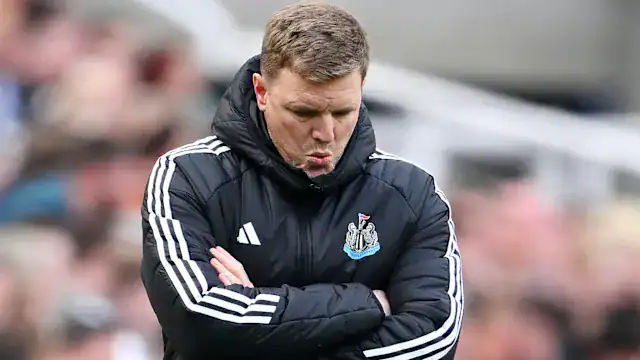
Too often, this team looks to Eddie Howe for answers mid-game rather than finding them collectively on the pitch. Without Kieran Trippier, the natural organiser, the problem-solver, that absence is felt.
And yet, this squad is not inexperienced. Far from it.
There are hundreds of international caps spread across the team. Bruno Guimarães, Sandro Tonali, Yoane Wissa, Anthony Gordon, these are players who have seen every possible game state. They should not need solutions spoon-fed from the sidelines.
Leadership isn’t just about shouting. It’s about recognising patterns early. About adjusting positioning, tempo, risk. About someone deciding, this isn’t working, we need to change.
Against Manchester United, Newcastle kept knocking on the same door with the same rhythm. Against Burnley, when control began to slip, no one seemed to grab the game and slow it down or, conversely, reignite the press.
Howe can guide. He can prepare. But he cannot play the game for them. If Newcastle are to take the next step, responsibility must be shared more evenly.
Shoot. Please.
There is a hesitancy to Newcastle’s attacking play that borders on politeness.
Too often, promising shooting opportunities are passed up in favour of one more pass, one more touch, one more attempt to walk the ball into the net. When defences are deep and compact, this becomes self-defeating.
This squad has no shortage of players capable of striking from distance. Anthony Gordon. Harvey Barnes. Jacob Murphy. Bruno Guimarães. Sandro Tonali. All have shown, at various points in their careers, that they can hit a ball cleanly and accurately from outside the box.
And yet, they rarely do.
Aston Villa offer a useful comparison. They score goals from range not because they are reckless, but because they are opportunistic. Those shots force defenders to step out. They create rebounds. They win corners. They change the questions being asked of the opposition.
Newcastle, by contrast, often make defending easy. If the ball is never struck, the goalkeeper is never tested. If the goalkeeper is never tested, there are no second phases, no scrambles, no moments of disorder.
Shooting from distance is not a desperation tactic. It is a tool. Used wisely, it adds unpredictability. It keeps opponents honest. It turns blocked lanes into potential advantages.
If Newcastle are struggling to create clear chances, as they did against Manchester United, then they must give themselves another route to goal.
A January that will define the season
Taken in isolation, neither festive fixture was catastrophic, just disappointing. A narrow loss to Manchester United. A win against Burnley. But football seasons are shaped by trends, not snapshots. And the trend here is clear.
Newcastle are a good team searching for sharpness. They control games without always threatening. They play with intensity, but not for long enough. They look well-coached, but sometimes over-reliant on the coach. They have weapons they do not use often enough.
The encouraging part is this: none of these issues feel unsolvable.
Speed up the passing. Vary the attacking structure. Consider pairing the strikers. Demand intensity for longer stretches. Empower players to lead. Shoot more.
January looms large. Fixtures will come quickly. The table will tighten. Momentum will matter.
If Newcastle can take the lessons of these festive fixtures and apply them, truly apply them, there is still time to make this season something meaningful.
Christmas showed them the problems. The new year will show us whether they have the answers.