
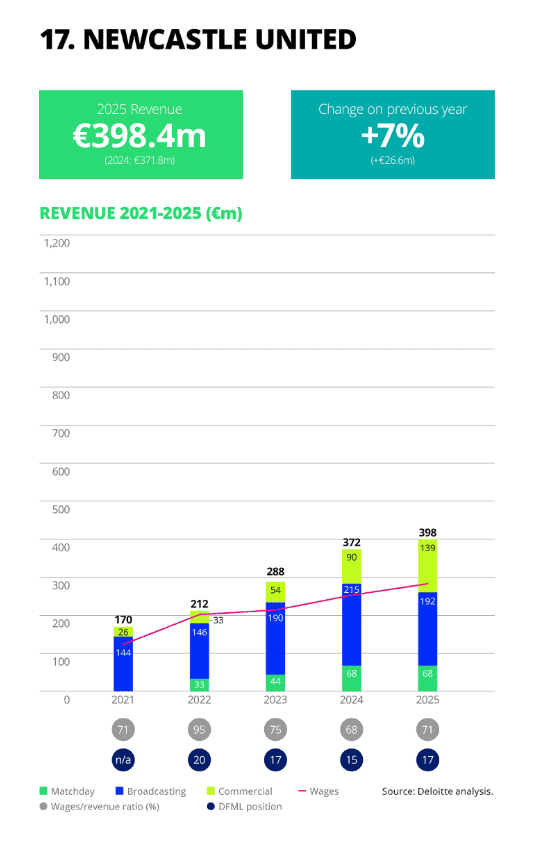
According to the Deloitte Football Money League 2026, Newcastle United generated €398.4m revenue in the 2024/25 season, ranking 17th in world football for revenue.
That figure matters for one big reason: it marks Newcastle United’s shift from being a “project club” to being a structural Money League club, with a revenue base that can support long-term competitiveness.
But it also raises a tougher question.
If Newcastle United want to stay in the Deloitte Football Money League and close the gap on clubs like Aston Villa, Tottenham or even the likes of Borussia Dortmund, the club must keep growing revenue not only through broadcasting or Champions League prize money, but through commercial revenue and matchday revenue that is less dependent on on-pitch performance.
And with PSR being replaced by a new Premier League financial system from 2026/27, Newcastle United’s revenue growth is about to become more important than ever.
What is the Deloitte Football Money League?
The Deloitte Football Money League ranks the highest revenue-generating clubs in world football. It focuses on revenue, not profit, and splits income into three streams:
- Matchday revenue (tickets, hospitality, in-stadium income)
- Broadcast revenue (domestic and UEFA distributions)
- Commercial revenue (sponsorship, retail, partnerships, events)
It is a backwards-looking report, meaning Deloitte Money League 2026 reflects the financial year ending 2025, which broadly corresponds to the 2024/25 season.
That matters when discussing future growth, because the Money League figures do not capture Newcastle United’s additional upside from later European qualification in 2025/26.
Note: Deloitte’s Money League revenue excludes player transfer income, so player sales do not sit inside matchday, broadcast or commercial figures.
Newcastle United’s Deloitte Money League revenue (2021 to 2025)
Deloitte’s Newcastle United chart provides a clear view of our revenue evolution since the takeover era began.
From 2021 to 2025, Newcastle United’s total revenue rose from €170m to €398.4m, more than doubling over four seasons.
Newcastle United total revenue:
- 2021: €170m
- 2022: €212m
- 2023: €288m
- 2024: €371.8m
- 2025: €398.4m
Newcastle United matchday revenue: why it has plateaued at €68m
One of the standout points in Deloitte’s numbers is that our matchday revenue appears capped.
In both 2024 and 2025, Newcastle United reported:
- Matchday revenue: €68m
That flatline matters because matchday income is supposed to be the most “controllable” revenue stream for clubs: it’s the one you can grow through ticket yield, premiumisation and stadium utilisation.
Some will look at those numbers and immediately shout “new stadium” but the Deloitte figures don’t actually prove that.
Why matchday revenue is capped: size doesn’t (really) matter
Matchday revenue is driven by:
- Yield per fan (pricing and hospitality, not just capacity)
- Number of home fixtures (cup runs, Europe, extra matchdays)
- Hospitality volume and quality
- Non-matchday utilisation (events, tours, fan experiences)
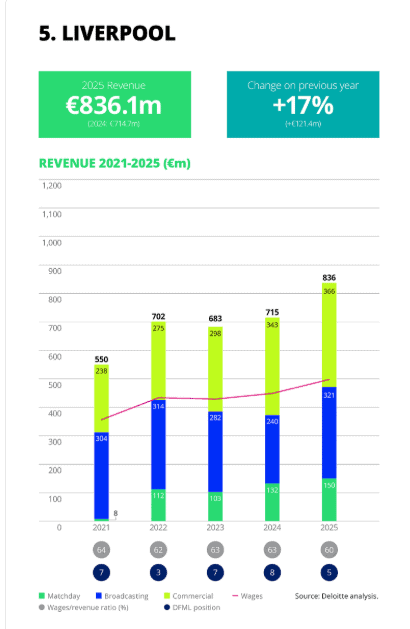
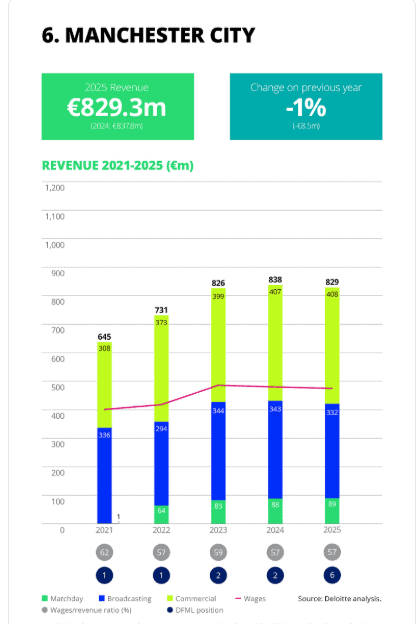
Manchester City generate elite matchday revenue without having a stadium massively bigger than St James’ Park, and Anfield is not dramatically larger either. Size is not destiny.
More competitions = more matchday revenue
A club that competes in more cup competitions and goes deep into them will naturally generate more matchday revenue, because it hosts more home games. Champions League participation adds high-demand fixtures that can be monetised without necessarily squeezing out regular match going fans.
This matters when thinking about 2025/26 and beyond.
Where safe standing fits
This is where safe standing and incremental capacity increases at St James’ Park make strategic sense. Rather than committing to a costly, disruptive new stadium build, gradual expansion and safe standing can deliver earlier matchday uplift and preserve atmosphere, while keeping options open long-term.
If you want the deeper version of the argument, read our full Safe Standing deep dive.
Newcastle United broadcast revenue: the volatility problem
The Deloitte numbers also show Newcastle United’s risk profile.
Our broadcast revenue fell from 2024 to 2025:
- Broadcast revenue 2024: €215m
- Broadcast revenue 2025: €192m
- Change: -€23m
This is the reality of being a Money League club outside the global top ten.
For clubs ranked roughly 11 to 20, broadcast revenue is still a major driver, and it is heavily influenced by:
- league position
- UEFA participation
- UEFA progression (group stage vs knockouts)
This creates volatility, and it’s exactly why Deloitte repeatedly emphasise the importance of commercial growth.
Newcastle United commercial revenue: the key Deloitte Money League insight
If you take one stat from Newcastle United’s Money League performance, make it this one:
Newcastle United’s commercial revenue jumped from:
- Commercial revenue 2024: €90m
- Commercial revenue 2025: €139m
- Change: +€49m
That is enormous growth.
And it changes the story.
Because Newcastle United didn’t simply grow because UEFA money arrived. we grew despite a fall in broadcast revenue, because commercial revenue exploded.
This suggests that we are starting to build what Deloitte Football Money League clubs need to survive long-term: a commercial engine that can carry the club even when European football disappears.
Deloitte Money League 2026 does not include Newcastle United’s 2025/26 Champions League upside
A major caveat: the Deloitte Money League data here does not capture the future upside from participation in the 2025/26 Champions League season.
Champions League qualification can increase:
- UEFA prize money
- UEFA broadcast distributions
- matchday income (extra premium fixtures)
- commercial leverage (sponsorship and retail)
This is why Newcastle United’s €398.4m is now best viewed as a baseline, not a ceiling.
Aston Villa comparison: how Champions League drives revenue growth
A perfect Premier League comparator is Aston Villa.
Like Newcastle United, Villa are ambitious but not a global superbrand. Deloitte’s numbers show the Champions League effect clearly.
Aston Villa revenue grew from:
- €310.2m (2024)
to - €450.2m (2025)
That is a +45% increase, worth around €140m in one season.
The uplift was across all revenue streams:
- matchday increased
- broadcast increased
- commercial nearly doubled
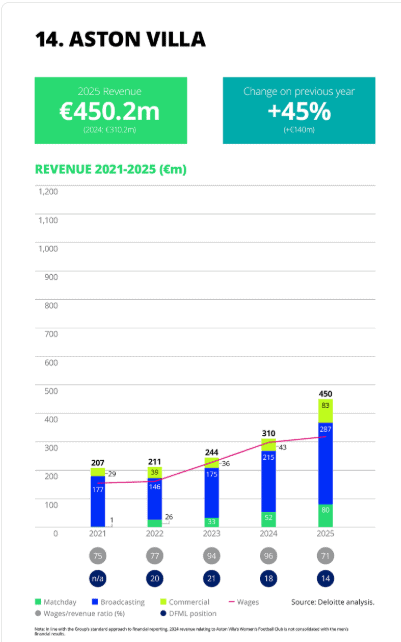
Villa demonstrate that Champions League does not just raise broadcast income; it raises the entire revenue model.
Borussia Dortmund comparison: Our realistic next-tier blueprint
If you want the best external league comparator for Newcastle United, it is Borussia Dortmund.
Dortmund are not Real Madrid. They are not Manchester United. They are not a superclub.
But they are a club with:
- huge local support
- strong stadium identity
- consistent European pedigree
- a highly developed matchday + commercial model
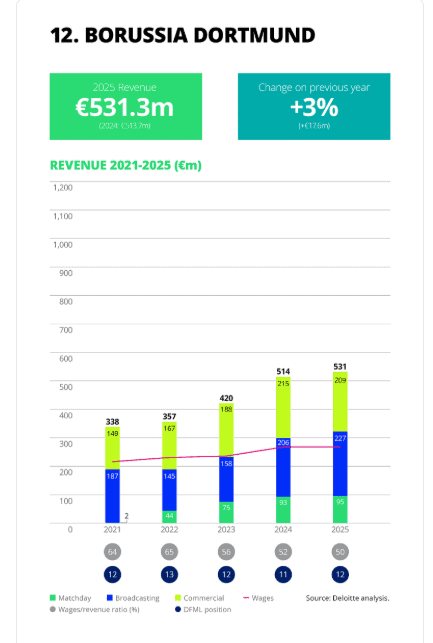
Dortmund generated:
- €531.3m revenue in 2025
Their revenue split is instructive:
- matchday around €95m
- commercial around €209m
When compared to Newcastle United:
- Newcastle United matchday: €68m
- Newcastle United commercial: €139m
That is our logical next step.
Newcastle United commercial revenue gap vs other English clubs
Even after commercial growth, we still have headroom.
Newcastle United’s commercial revenue (2025):
- €139m
Compare that to:
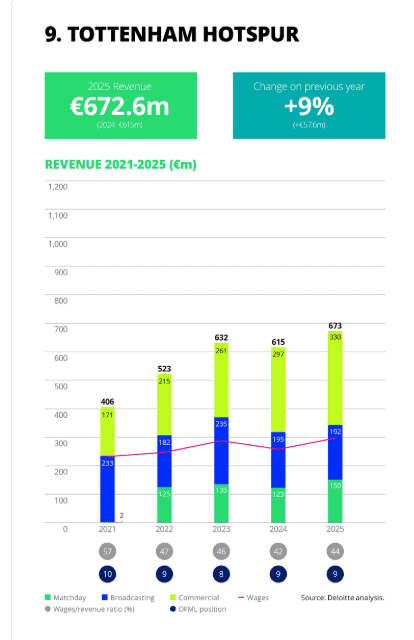
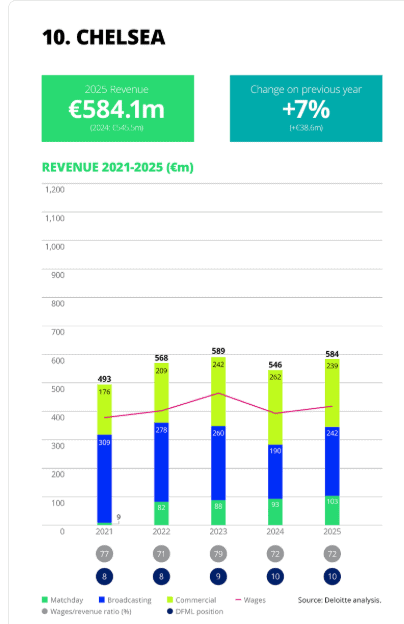
- Chelsea: €239m
- Tottenham: €330m
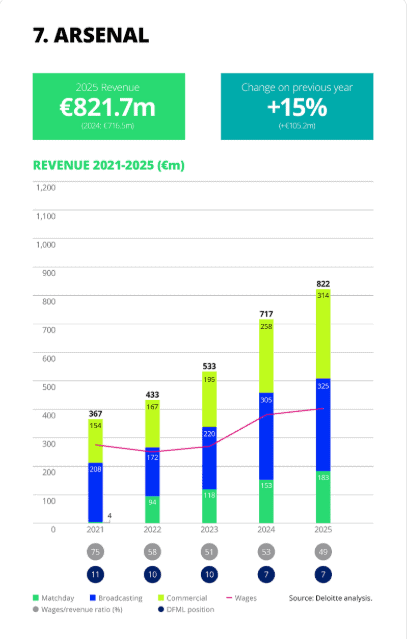
- Arsenal: €314m
- Liverpool: €366m
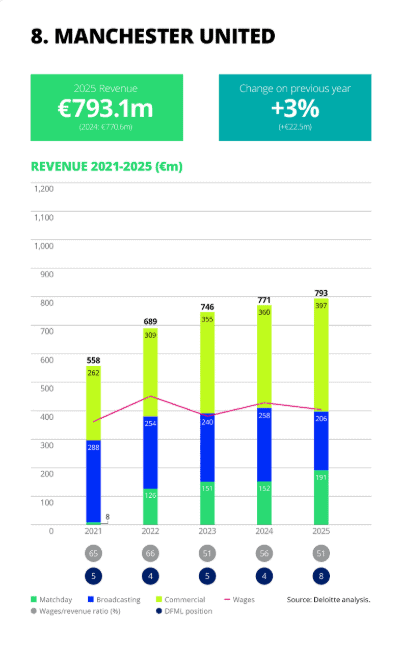
- Man City and Man United: close to €400m commercial
This supports a clear conclusion:
Our commercial growth is not just possible, it is necessary to close the gap.
PSR is ending: why the Premier League Squad Cost Ratio makes revenue growth essential
This is the quiet but decisive point.
The Premier League has confirmed that a new financial system will replace PSR from the 2026/27 season, including:
- Squad Cost Ratio (SCR)
- Sustainability and Systemic Resilience (SSR)
SCR limits on-pitch spending to 85% of football-related revenue (plus player trading).
UEFA’s squad cost rules are even stricter, at 70%.
So football is moving from a “loss control” era (PSR) into a “spend relative to revenue” era (SCR).
That means:
In the PSR era, clubs survived through accounting.
In the SCR era, clubs survive through revenue.
For Newcastle United, this makes commercial and matchday growth more strategically important than ever.
What success looks like in 2025/26 (and the number we should target)
So what should Newcastle United realistically be aiming for next season? Put bluntly: a €450m revenue season.
Deloitte have Newcastle United at €398.4m in 2024/25, and Aston Villa’s most recent Champions League campaign shows how quickly a club in our bracket can jump when UEFA income, premium matchdays and commercial leverage all move at once. If Newcastle United can use Champions League participation to add roughly €50m across UEFA distributions, higher-value matchdays and further commercial uplift, then €450m is the right target for 2025/26.
That wouldn’t make us a superclub overnight. But it would push us into the next Money League tier, raise the revenue floor beyond the volatility of broadcast swings, and create much-needed headroom as the Premier League moves towards a squad cost ratio system where spending power is increasingly tied to what you earn.
Conclusion: what Deloitte Money League 2026 reveals about Newcastle United
The Deloitte Football Money League 2026 numbers show a Newcastle United club in transition:
- Newcastle United generated €398.4m revenue and ranked 17th in the world
- broadcast income remains volatile
- matchday income has plateaued at €68m
- commercial revenue surged to €139m, the key growth driver
Newcastle United do not need to become Manchester City overnight.
But the roadmap is clear:
- use Champions League seasons as accelerators
- keep expanding commercial revenue
- unlock matchday growth through yield, utilisation and incremental improvements
- build a revenue base strong enough to thrive under the Premier League SCR era
In Money League terms, Newcastle United’s realistic next-tier target is Borussia Dortmund.
And to get there, Newcastle United must do what Deloitte repeatedly says the modern elite do best:
grow revenue off the pitch.