A frustrated reckoning with Newcastle United’s absentee overlords
When Newcastle United were bought for just over £300 million in November 2021, fans were jubilant. Mike Ashley’s joyless reign was finally over. In his place came the richest ownership in world football: the Saudi Arabian Public Investment Fund (PIF), with an 80% stake in the club.
It was a moment loaded with significance. On the one hand, a euphoric release from years of underinvestment and mediocrity. On the other, a wave of media condemnation, political scrutiny, and a full-throated moral debate that landed almost entirely at the feet of Newcastle United fans.
Never mind that our own government rolled out the red carpet for Mohammed bin Salman. Never mind that the UK flew the Union Jack at half-mast when King Abdullah died in 2015. Never mind the billions in arms sales and energy partnerships. When it came to Newcastle United, suddenly everyone grew a conscience.
If we were going to be owned by a sovereign wealth fund, fine. But surely the point of selling your soul was at least to get something back? So here we are, nearly four years on. And the question Newcastle fans are increasingly asking is: what is the point of PIF?
The richest owners in football… unless it’s for Newcastle United
Let’s be clear: this isn’t a question of resources. PIF have spent tens of billions transforming Saudi Arabia into a global sporting powerhouse:
Golf: nearly $4.6 billion funnelled into LIV Golf—with projections rising above $5 billion.
Boxing: hosting undisputed world title fights and the blockbuster “Riyadh Season”.
Formula One: a long-term deal bringing the Saudi Arabian Grand Prix to Jeddah.
WWE: over $100 million spent to host events like Crown Jewel and Elimination Chamber.
Club World Cup: rebranded and rebooted with Saudi backing; the next edition will be hosted in Saudi Arabia.
Domestic football: more than $3 billion spent on wages, transfer fees, and infrastructure, luring Cristiano Ronaldo, Neymar, Benzema and dozens more to the Saudi Pro League.
This is not cautious or conservative investment. It’s aggressive, strategic, and turbo-charged. The four PIF-owned clubs in the Saudi Pro League: Al-Hilal, Al-Nassr, Al-Ittihad, and Al-Ahli, have had money hurled at them to rebuild their squads, inflate their global profile and act as shop windows for Vision 2030.
And when those clubs need something? PIF delivers.
When Newcastle United needs something? We break out the PSR spreadsheets and pray someone bids for one of our academy graduates.
Trapped by regulation… or by choice?
Yes, the Premier League’s Profit and Sustainability Rules (PSR) and the hasty introduction of Associated Party Transaction (APT) restrictions have limited our freedom of manoeuvre. The latter of which were introduced specifically to curtail the financial power of a state-backed Newcastle United.
But that only explains so much. Other clubs are finding ways to play the game:
Chelsea sold both hotels and their women’s team to themselves.
Aston Villa sold their women’s team, also to themselves.
Nottingham Forest deliberately overspent, took a points deduction, and stayed up to then kick on the following season for European qualification.
There are legal grey areas being exploited across the league. Meanwhile, Newcastle United appear paralysed by self-imposed caution. The 2024 summer window should have been planned months in advance. Instead, we were reduced to a PSR deadline day scramble, forced to sell Yankuba Minteh and Elliot Anderson in a transparent attempt to balance the books.
We were told that we’d hired the brightest legal and financial minds who would know how to play the regulations like a fiddle. Instead, we were scrambling around like incompetent amateurs and went for the second successive summer window without significantly strengthening the first-team squad.
A transfer window without a plan
If PSR could have been an excuse for the last two years of transfer inactivity, it isn’t one now. We are now well over a month into the 2025 summer transfer window, and Newcastle United have signed exactly one player: Anthony Elanga. A decent squad addition, sure, but hardly the kind of transformative signing that considerably moves the needle for a club pushing for Champions League football.
Our marquee pursuits? Nothing short of embarrassing.
We were beaten to João Pedro by Chelsea, and Hugo Ekitike, who we’ve hovered around for over three years, looks set to join Liverpool. Both players rejected us. That’s not an isolated incident, it’s a pattern.
Liam Delap? Gone to Chelsea.
Dean Huijsen? A year too late as he’s now gone to Real Madrid.
Bryan Mbuemo? Interest faded once we realised he wanted Manchester United.
James Trafford? Even the rather uninspiring pursuit of a Championship goalkeeper looks set to end in failure. Despite circling him for over a year Burnley want £40 million, as that’s the buy-back Manchester City hold on him and now look set to exercise. Why didn’t we just move on?!
We either underbid, or we hang on too long, and by the time we’re ready to move, someone else has beaten us to the punch.
Why? Because we don’t have an empowered leadership structure. There is no decisive CEO. No stable football director. No executive capable of moving quickly when an opportunity presents itself.
Every decision has to go up the chain to PIF, and by the time it comes back down? It’s too late. This is exactly what Eddie Howe warned against at the end of last season, the need for speed, clarity, and decisiveness in the market. What he got instead was bureaucratic inertia dressed up as strategy.
Let’s be honest: we like to act like we can sit at the top table, but right now we don’t have the structure, authority, or ruthlessness to back it up.
So, if we can’t outspend or outmuscle? Then we need to outthink.
Go back to what worked:
Buying top players on the back of a dip season, like Isak.
Spotting breakout talent just before they explode, like Bruno and Botman.
Working under the radar, like with Tonali.
Right now, this club doesn’t need a transfer committee, it needs a plan, and someone empowered to execute it. Until that changes, expect more windows like this one: reactive, indecisive, and ultimately disappointing.
Revenue growth: the bare minimum, badly delivered
Peter Silverstone can trumpet 90% commercial growth all he wants. It doesn’t change the fact that the club was starting from an anaemic baseline under Ashley, and the bulk of that growth has come from hand-fed Saudi deals: Sela, Noon, Saudia all closely tied to the Saudi state – a rare instance of PIF support for the Newcastle United project.
We have Adidas back as a kit manufacturer, which is great, but given our iconic association with them during the Entertainers era, that was hardly a masterstroke.
Meanwhile, we’re still lacking a training kit sponsor, a training ground sponsor, and have seen no movement on naming rights for St James’ Park. These are basic commercial wins that a serious ownership group would have prioritised from year one.
Matchday revenue tells a similar story. Prices are going up, season ticket holders on long-term frozen deals have been moved onto higher tiers, and general ticket prices have seen a 5% hike. Some of that was inevitable. But the club are now actively reducing the number of season ticket holders, knowing they can sell individual match tickets at inflated prices through ballots or general sale. It’s short-termist and cash-grabby, not part of a long-term fan engagement plan.
On-pitch miracles masking off-pitch inertia
If Newcastle United’s finances are afloat, it’s thanks to Eddie Howe. He’s secured Champions League qualification twice, won our first major domestic trophy in decades, and dragged an injury-ravaged, thin squad to top-eight two seasons ago before working miracles with a squad that hasn’t been strengthened in 3 years to 5th last season.
But he’s been doing it without the tools he needs. While our competitors reinforce, we tread water. There’s no depth. No long-term succession planning. No sign that our owners are building the platform required to sustain success.
You can’t keep asking the manager to work miracles while giving him a squad one injury away from collapse. That’s not strategy. That’s an unsustainable house-of-cards that will collapse in on itself when the manager eventually walks.
Strengthening our rivals: PIF’s most baffling betrayal
It gets even more maddening when you realise PIF aren’t just neglecting us, they’re actively strengthening our direct competitors.
Take the Club World Cup. The Saudi-funded reboot of the tournament handed Chelsea a massive financial and commercial boost. They’ve leveraged it to attract players, sponsors and attention and bankrolled it to the tune of $1.5 billion.
This summer, João Pedro and Liam Delap, two players Newcastle were interested in, both signed for Chelsea. Not because Chelsea is smarter or better-run, but because they had the financial freedom to outbid us. Freedom made possible, in part, by the influx of Saudi money into their coffers.
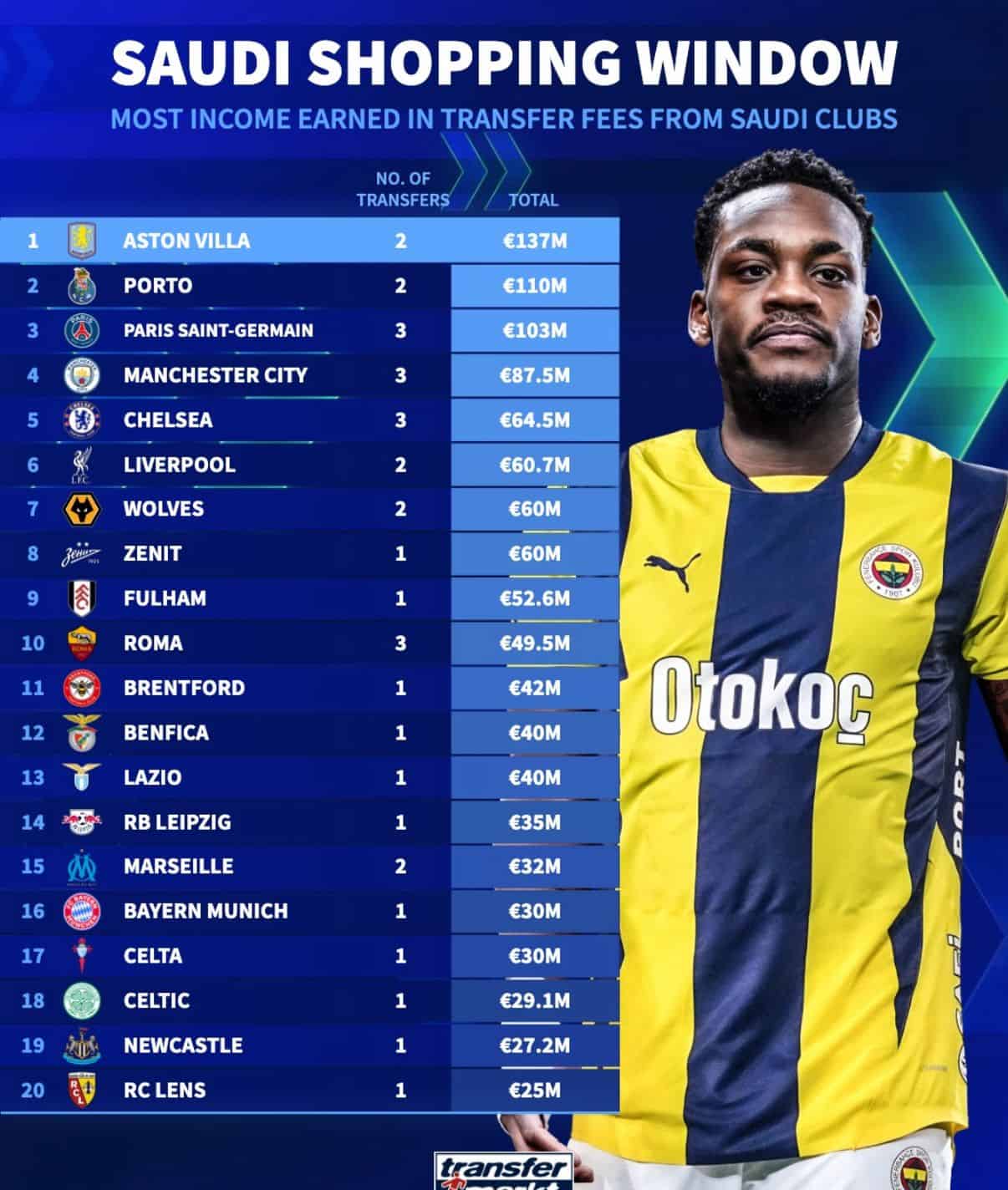
Let’s look at the numbers. The four PIF-owned Saudi Pro League clubs spent an eye-watering €350 million on Premier League players last year.
Aston Villa, one of our direct competitors, received €137 million of that.
Newcastle United? Just €37 million.
Even more galling, PIF are reportedly in talks to secure a stadium naming rights deal with Tottenham Hotspur. That’s right, our owners are negotiating a deal to fund the infrastructure of one of our top-four rivals, while we sit here with no training ground sponsor and no long-term plan for stadium expansion.
And the final insult? Reports have now emerged that Al-Hilal, the most lavishly funded of the Saudi clubs owned by PIF, are interested in signing Alexander Isak, Newcastle United’s best player, our talisman, and arguably the most gifted striker we’ve had since Alan Shearer.
Those tasked with elevating the club are threatening to strip it for parts.
Where is the ambition?
We are now four years post-takeover, and there is:
No confirmed site for a new training ground.
No CEO lined up, ten months after Darren Eales announced his departure.
No clarity on succession planning in the football leadership, with Dan Ashworth poached by Manchester United and Paul Mitchell already out the door.
No visible communication from PIF figures.
No Amanda Staveley or Mehrdad Ghodoussi. the two only voices in the ownership group who seemed to actually care.
Even the women’s team, which sits outside PSR restrictions and could be turned into a European force with relative pennies, has been practically sidelined since Staveley’s departure. PIF have shown zero interest in building a legacy. They’ve shown zero understanding of what this club means to its community.
So what is the point of PIF?
They don’t challenge unfair rules. They don’t maximise commercial opportunities. They don’t build infrastructure. They don’t communicate. They don’t support the women’s game. They don’t protect our best players. They don’t back the manager. They don’t seem to care.
And yet they happily fund everyone else.
When the takeover happened, Newcastle fans were asked to carry the moral burden of state ownership. We were expected to justify it, to apologise for it, to accept that the club we love was now part of something bigger, something geopolitical.
Fine.
But if we’re going to be a cog in a state machine, at the very least we should be, if not its main priority, a material consideration.
Instead, we’re a neglected asset. A forgotten project. A box ticked on a spreadsheet in Riyadh.
So again, and this time louder for those at the back: what is the point of PIF?
Because if they can’t answer that question, they shouldn’t be here.