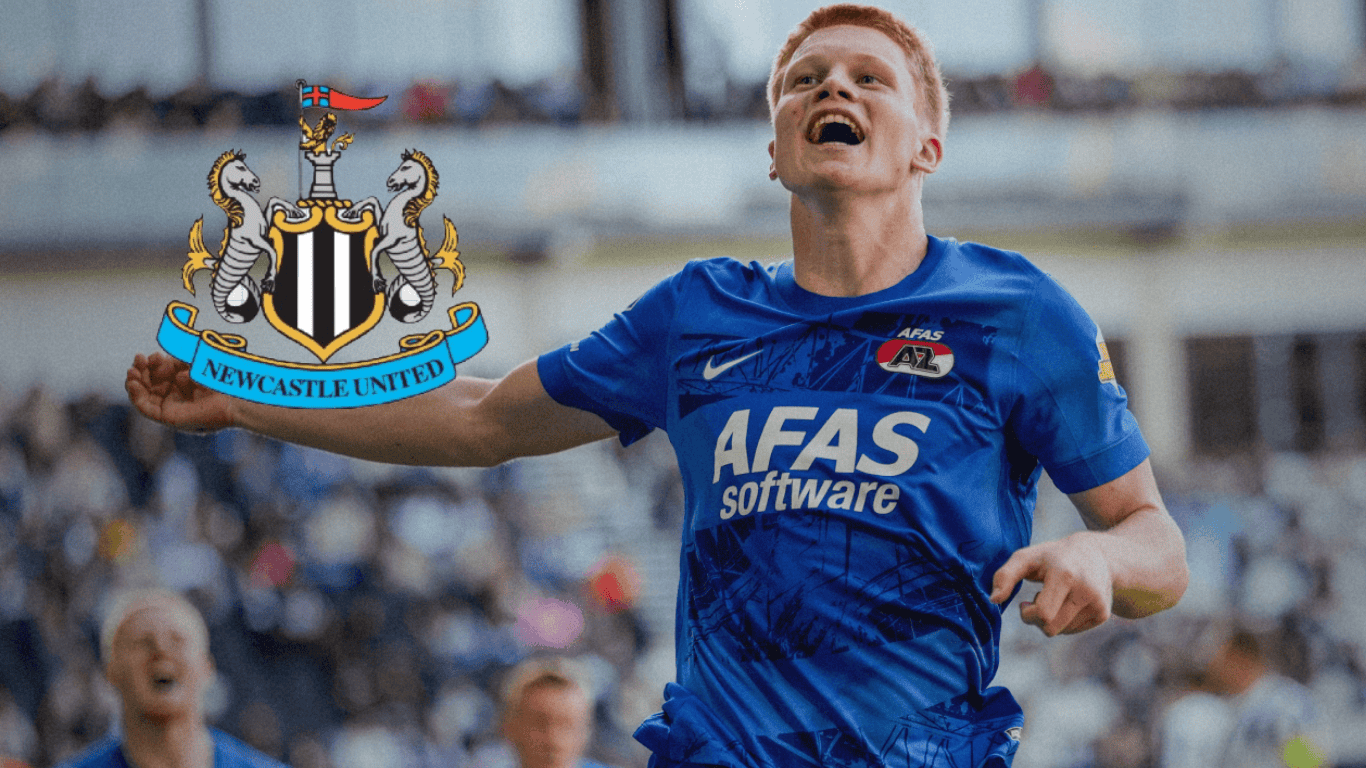
What does Cathal Heffernan’s sale really say about the failings of Newcastle United’s academy?
There is a version of this conversation that is unfair.
The version where every academy player who doesn’t become a Premier League starter is treated as evidence of incompetence. The version where people pretend development is linear, or that all prospects bloom on schedule, or that loans are a controllable science rather than a chaotic negotiation between minutes, managers, injuries and timing.
That is not what this article is.
Because the truth is simple: most academy players do not make it. Most clubs lose more prospects than they “hit”. Even the best run youth systems in Europe produce disappointment alongside success.
And Newcastle United have produced academy players who made it in recent years.
Sean Longstaff. Elliot Anderson. Lewis Miley.
All three deserve to be recognised as genuine success stories. They climbed into senior football, played meaningful minutes, and became proof that St James’ Park can still be the end point of a pathway.
But there is a wrinkle in the post-takeover story that matters.
All three were already part of the club set-up before PIF arrived. And Miley, in particular, feels like the kind of talent that would have broken through in almost any era, because some players are simply too good to be contained by the usual friction of “pathways”. They force the door down.
So yes: Newcastle United can produce.
But the fair question is whether Newcastle are producing enough, and whether the club has built a coherent system that turns young players into senior footballers, or saleable assets, with any regularity.
Which brings us to the fair version of this conversation.
What is fair is to judge Newcastle United on whether the club has built a coherent pathway that:
develops youth talent into senior footballers
places players in loans that accelerate growth
and turns academy assets into meaningful market value, even when they don’t make the first team
And that is where the uncomfortable conclusion begins to form.
Because four years after the takeover, Newcastle United’s academy pathway is not producing enough of any of those outcomes.
Instead it is producing drift. It is producing loans that fail to create momentum. And it is producing exits that feel more like quiet clear-outs than properly monetised sales.
And if you want a single case study that exposes the problem, it is Cathal Heffernan.
An academy signing that should have meant more
When Newcastle signed Cathal Heffernan from AC Milan’s academy, it wasn’t a marquee deal. Nobody was putting him on the back of a shirt.
But it should have represented something important.
AC Milan’s youth system is a serious environment. Players aren’t just handed professional development there for fun. If you’re coming through that pipeline, you are at minimum being regarded as a credible professional prospect.
Newcastle United identifying a player in that market and bringing him to England should have been a sign of competence: recruitment reach, a clear plan, a club serious about building a modern academy model.
What followed, in isolation, looked like exactly what you’d want from a prospect in his situation.
He played. Every week.
Heffernan became our starting centre back at Under-21 level and made over 50 appearances there. Not cameos. Not being “kept around”. He was trusted as a regular for three years.
That kind of profile normally leads to one of two outcomes:
a senior loan ladder that tests the player properly
an exit to a good level that generates meaningful value
Instead, he has been sold to League Two.
And it’s the level that matters, not the sale itself.
The issue isn’t that he left. It’s where he went.
Academy exits happen, and they should happen on a regular basis. That isn’t the scandal.
The scandal is that Newcastle United have spent three years developing a consistent Under-21 starter, signed from a top European academy, and the end point is a move at the bottom of the professional pyramid.
A League Two sale is not automatically humiliating. But it is revealing.
It strongly suggests Newcastle United have not managed to create either:
a credible senior development pathway for him
or a strong enough external market to make him a desirable asset
Which means failure somewhere upstream:
recruitment (overrating the ceiling)
development (not elevating his level)
loan planning (no ladder)
market building (no demand)
or indecision (time passed, value drained)
And whichever mixture applies, the outcome is the same.
Newcastle United have failed to turn a credible youth signing into a valuable asset.
The loan system isn’t helping. It’s leaking value.
This is where Heffernan stops being a one-off and starts being a symbol.
Because the same thing has been happening across the club’s development ecosystem: players being moved without meaningful progression, or left static until the only possible outcomes are low-level exits.
If you look at the current landscape, the examples stack up quickly:
Antonio Cordero requiring a mid-season reset after a loan spell that didn’t work
Joe White being sent back early, which is far more damning than a parent club recall
Harrison Ashby drifting through moves that haven’t clarified his future or increased value
Miodrag Pivaš barely playing across an entire season, effectively stalling his development
and even cases like Trevan Sanusi, where injury intervenes but the broader fragility of the pathway remains
You can read a more detailed piece examining our issues loaning players here.
The point isn’t “every loan fails”.
The point is that Newcastle United are not consistently using loans to achieve what modern clubs use them for: momentum, senior minutes, and value creation.
The result is drift.
And drift is brutal in football, because drift turns prospects into sunk costs.
The red flag is also who isn’t being loaned
There is another, quieter symptom that might be even more worrying.
The lack of a coherent ladder doesn’t just show up in the loans that go wrong. It also shows up in the loans that don’t happen at all.
Sean Neave. Leo Shahar. Alex Murphy.
Players hovering at exactly the age where a well-chosen senior loan usually matters most. The age where youth football stops being enough, but first-team minutes are still a stretch.
The danger is obvious: you keep them in the Under-21s too long, and you don’t protect them with a proper senior pathway. Then their value stagnates, then the market disappears, and eventually the exit becomes a quiet clearance sale.
That is how a player like Heffernan ends up going to League Two after three years of being a regular at U-21s.
Not necessarily because he was hopeless. In fact, I think he will quickly climb the football ladder exposing our failings further.
But because the club didn’t build a ladder.
…and then there’s Garang Kuol: excitement without a pathway
If Heffernan represents the failure to build value out of a steady, trusted Under-21 profile, Garang Kuol represents a different kind of Newcastle United failure.
Not that Kuol was some guaranteed superstar.
He wasn’t.
He was raw. He was speculative. He was the kind of youth punt that might become something if handled correctly.
But there was genuine excitement around him, and it wasn’t irrational.
A teenager who had represented Australia at a World Cup and who had already raised eyebrows with a scintillating cameo against Barcelona. A player who arrived with buzz. A signing Newcastle supporters wanted to believe in.
Then he entered the same ecosystem.
Loans that didn’t really build him. Environments that didn’t seem tailored to what he needed. No stable progress you could point to and say: that’s the club shaping a high-upside asset.
And then he was sold to Sparta Prague.
Again, that sale itself isn’t scandalous.
But the overall story is telling: Newcastle did not turn early excitement into either first-team contribution or meaningful resale value. They watched the buzz fade, then cashed him out.
That is how clubs lose value.
That is how development becomes disposal.
Minteh: the exception that proves the rule
The one reason this conversation hurts is because Newcastle United have shown they can do it properly.
Yankuba Minteh is the best example. Signed young, loaned into an environment that suited him, given minutes, improved, and emerged as a valuable asset.
He provided what the best loans always provide:options.
Minteh could have been first-team depth. He could have been a long-term squad player. Instead he was sold because PSR squeezed Newcastle United into a hard decision.
But the loan still did what it was meant to do: it created clarity and value.
The problem is that Minteh feels like proof of concept, not proof of system.
Why this is a huge failure of the PIF-led owners
At some point, the clock matters.
We are four years post takeover. Newcastle United are now operating in a PSR reality where the entire sport is being pushed towards regular player trading.
The club cannot sustainably grow while relying on disruptive “big sales” to balance the books. Selling a star might solve a financial problem, but it risks destabilising the squad and, crucially, telling elite players that Newcastle United is not a destination.
The smarter model is simpler:
smaller but regular profits
less upheaval
more control
That model requires Newcastle United to produce saleable assets.
That is why academy outputs matter, even when those players never make the first team. And that is why low-level exits are such a problem. They represent value not just failing to grow, but shrinking.
Heffernan to League Two is the sound of a development asset depreciating.
Kuol leaving without the club ever properly maximising him is the sound of value leaking.
And when those stories become common rather than rare, you stop blaming bad luck and start blaming the institution.
Ross Wilson may fix it but it doesn’t erase the indictment
Ross Wilson arriving as sporting director offers a chance for reform. Some recent movement suggests the club might finally be taking asset management seriously.
But corrective action doesn’t erase what came before.
Resetting loans, clearing house, and moving players on faster may be necessary. It may even be healthy.
But it also underlines the larger truth: this is inherited dysfunction. And it has existed throughout the takeover years.
What Cathal Heffernan’s sale really says
This isn’t a rant about one player.
It’s a warning about a system.
Heffernan’s sale to League Two doesn’t prove Newcastle United can’t develop players.
But it does suggest the club can’t consistently build pathways.
And in a PSR era where academy products are one of the cleanest financial levers a club can pull, that isn’t just “one of those things”.
It’s a strategic failure.
Because Newcastle United cannot become truly elite while allowing youth assets to drift, stagnate, and depreciate until the only possible outcome is the quiet sale at the bottom of the pyramid.
That is what Cathal Heffernan’s sale really means.