For a club that has redefined the speed and scale of its rebuild, Newcastle United’s left back spot has been a slow burn and a running debate. Two very different interpretations of the role, Dan Burn’s defensive certainty and Lewis Hall’s natural, forward-leaning profile, have coexisted across the last three seasons, shaping the team’s balance, the centre-back partnerships inside them, and the way Eddie Howe’s side looks when it tries to tilt the pitch to the left.
Burn was a mid-winter signing who felt like a much needed stabiliser. He arrived in January for a modest fee and made an immediate impact, slotting in with a calm authority that helped galvanise the back line. Hall followed the next summer for significantly more money, a long-term bet on athleticism, technique and youth. He was eased in slowly and only began to see regular Premier League minutes when Sven Botman’s injury opened a gap in the defence; that vacancy nudged Burn inside to centre-back, a switch that suited him, calmed some increasingly pointed criticism about his mobility at full back, and rehabilitated his stock with the fanbase.
This is a story about how Newcastle look with each of them at left back across recent campaigns, why the numbers don’t always match the eye test, and what the ideal back four might soon become.
The Profiles: Immediate Assurance vs. Projectable Upside
Dan Burn joined in January and slotted straight in. The headline wasn’t the fee so much as the fit: a 6ft 7in defender who could play as a conservative left back in a back four, pinch inside as a third centre-back when Newcastle held possession, and give Howe a set-piece anchor at both ends. His introduction coincided with an uptick in defensive control, the kind of addition supporters feel as much as they see.
Lewis Hall arrived the following summer with a different proposition: a youth team midfielder converted to left back, comfortable receiving under pressure, progressing through the thirds, and overlapping or underlapping to free the winger outside him. He was groomed, not thrust, into the role. And it wasn’t until Botman’s absence that Hall’s minutes turned regular, because Burn’s shift into centre-back created an opening on the left.
Where Burn projected certainty and structure, Hall suggested fluidity and future value.
What the Numbers Say About Burn—And Why They Surprise
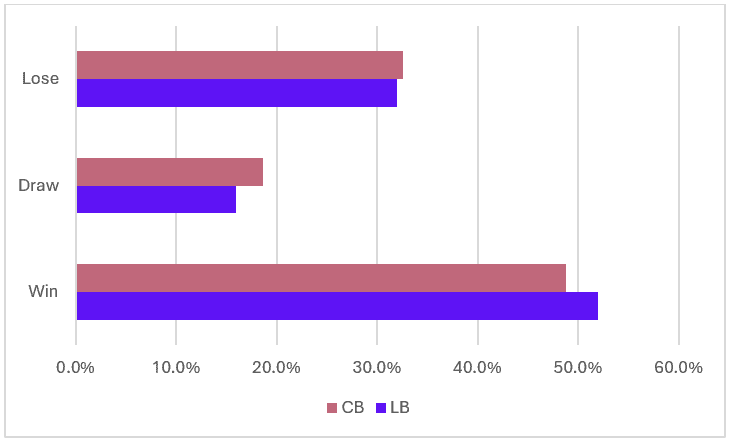
Across his Newcastle Premier League career, Dan Burn has played 68 matches—25 as a left back and 43 as a centre back. The headline results are tighter than perception might predict. With Burn at left back, Newcastle’s win percentage is 52.0% and the loss percentage is 32.0%. With Burn at centre back, the win percentage is 48.8% and the loss percentage is 32.6%.
On paper, that’s almost identical, with a slight edge to Burn as a left back in wins. For many supporters, that will jar with the watching experience. Burn can look stretched when isolated in wide defensive duels or when asked to defend the far post against quick switches. He is not an explosive 1v1 athlete; transitions into his channel can feel perilous; and his crossing quality is naturally lower than an attack-first full back.
Graph: The graph shows the win, draw and loss percentages for Newcastle when Dan Burn has played as a left back vs when played as a centre back.
So why do the results look so similar, or even tilt slightly towards left back?
A significant part of the answer is context. When Burn plays on the left, Newcastle typically get their strongest available centre-back pairing in the middle, Botman with Schär, or more recently Botman with Thiaw. That raises the team’s baseline: build-up is cleaner, aerial dominance more assured, and defensive positioning more consistent when Botman anchors the line. When Burn moves inside to centre-back, it is often at the expense of Botman, and Newcastle lose their calmest, classiest defender. That tradeoff flattens the numbers.
Hall’s Returns—Promise, Territory, and a Different Kind of Threat
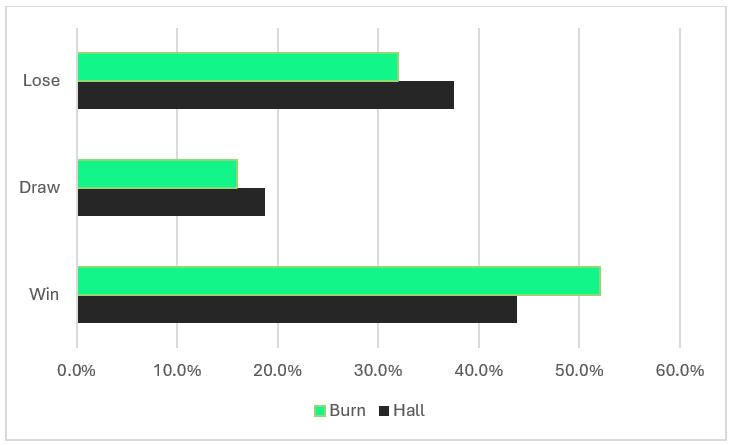
Lewis Hall has played 48 Premier League games for Newcastle, all at left back. The win percentage sits at 43.8%, with a loss percentage of 37.5%. Compared directly to Burn’s left back sample, those returns are slightly worse.
Graph: The graph shows the win, draw and loss percentages for Newcastle when Dan Burn and Lewis Hall play as the left back.
That’s surprising in another way. Hall is plainly more natural at the position. He opens his body to play forward, hits first-time passes into the inside channel for the No. 8, and more readily offers width to pin an opposing winger deep. He looks like an attacking outlet by design, not a centre-back improvising on the touchline. Hall has 4 league assists across those 48 games—not a huge tally, but enough to force opponents to respect his overlaps and cut-backs, which in turn gives Anthony Gordon (or the left winger) more space to isolate defenders or arrive unmarked at the back post.
So why don’t the results roar in his favour? Again: context. Hall’s heaviest run has coincided with centre-back reshuffles and injury-managed spells for Botman. The left side is a collective: full back plus left centre-back plus left-sided No. 8 plus the winger. Change one piece, especially the centre-back, and the geometry shifts for everyone. Especially when you consider that both Pope and Burn are not great ball players, the whole side becomes an afterthought.
Why Hall Still Feels—and Is—The Future
Hall gives Newcastle something different. His ability to shift the game’s balance is obvious—he can hold the ball under pressure on the touchline, cut inside to link play, or burst forward to stretch the defence. Those movements create space for Gordon, who thrives when he gets isolated against his marker and can attack the box with confidence.
What Hall offers isn’t just about assists. Even if the numbers aren’t spectacular, defenders have to respect his threat. That attention pulls them wider, which opens up lanes for midfielders or creates room for quick combinations. Sometimes the benefit is subtle—a second pass before the goal, or simply forcing the opposition to adjust their shape.
This matters because Newcastle are evolving. The first phase of Eddie Howe’s project was built on control and structure. The next step is adding attacking unpredictability without losing defensive security. Hall is one of the pieces that makes that possible.
To unlock his full impact, the back line needs balance. Pair him with Botman and Thiaw in the centre, and Livramento on the opposite flank, and Newcastle can press higher, attack with width, and still keep the middle solid against transitions.
The Bottom Line
If you just scan the numbers, you can make a case that Dan Burn at left back holds Newcastle’s results as well as, and sometimes a touch better than, other configurations, and you can fairly note that Lewis Hall’s returns are slightly worse in the aggregate.
But football is a chemistry set, not a spreadsheet. The split is as much about who partners whom as it is about who is the in any one position. Burn’s best left-back spells have come with Botman plus an in-form partner in the middle. Hall’s toughest stretches have coincided with centre-back churn.
Watch the games and the conclusion is clear: Hall is the superior left back, a more rounded modern fit who lifts Newcastle’s attacking ceiling. The hope, and the logic, is simple. Get Hall back at left back, Botman and Thiaw restored in the centre, and Tino Livramento back on the right. That back four blends quality, pace and thrust in a way that can unsettle even the league’s best.
And when the fixture state, opponent, or injury list demands something sturdier? Newcastle are fortunate. They can still turn to Dan Burn at left back, knowing the results won’t fall through the floor, and that his presence, in the right configuration, might yet tilt them up.