Specialise or Suffer: Why Newcastle’s Season Demands a Return to Their Core Identity
It’s tempting to brush off the table with the familiar refrain: “We’re only 11 games in.” But 11 games is more than a quarter of the campaign, and history has a way of turning early patterns into final truths. Last season, most Premier League sides moved no more than three places from their position after matchday 10 to where they finished in May. Spurs (down ten) and Newcastle (up six) were the outliers, not the norm. That matters, because the margin for a dramatic surge is slimmer than it feels, even in a congested pack with Newcastle only seven points off the top four. The message is stark: get it right now, or risk waiting on a swing that rarely comes.
This season, more than most, looks like it rewards teams that specialise, who do one or two things exceptionally, while punishing those who drift toward the middle ground. Newcastle’s poor start isn’t just about injuries, form, or an uneven fixture list. It’s about slipping away from the very edge they once honed sharper than anyone else.
“Intensity is our identity” — when identity frays, results follow
Eddie Howe’s mantra has defined his tenure: intensity is our identity. You can still see it, almost hear it, in the muscle memory of those seismic evenings and ruthless afternoons: Paris Saint‑Germain run over 4–1 on a Champions League homecoming night that felt like a re‑christening of the club or the 5–1 at West Ham when Jacob Murphy pinched the ball inside the six‑yard box as if he’d been born to ambush.
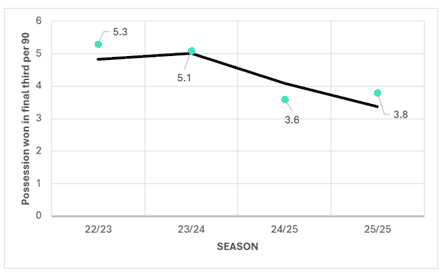
But the current league trend is drifting away from peak pressing, and Newcastle have followed that current. Possessions won in the final third—a clean proxy for high pressing—have fallen across the division, from a league average of 4.8 per game in 2022/23 to 3.36 in 2025/26. Newcastle mirrored that arc: 5.3 (22/23) and 5.1 (23/24) down to 3.6 (24/25) and 3.8 (25/26). Relative to the field this season, that’s still respectable, but the absolute decline matters. Those high regains weren’t just defensive actions; they were attacking triggers. They created the end‑to‑end chaos in which Newcastle thrive.
Bournemouth, under Andoni Iraola, are the notable exception, pressing relentlessly throughout a game, not just in a phase. They’re reaping the rewards, just a point off the top four and fully alive in the Champions League conversation. It’s a reminder: in a league of generalists, the specialist rises.
Image: Graph showing how Newcastle (green dot) compare to the season average for possession won in final third, between the 22/23 and 25/26 season.
The lost edge of speed: neither fast and direct, nor slow and intricate
Newcastle at their most dangerous don’t just press—they pounce. Goal kicks became traps; forwards coiled like sprinters, exploding as soon as the ball nudged into play. Even when they start high now, the press looks more laboured, more disconnected. And it shows further up the pitch.
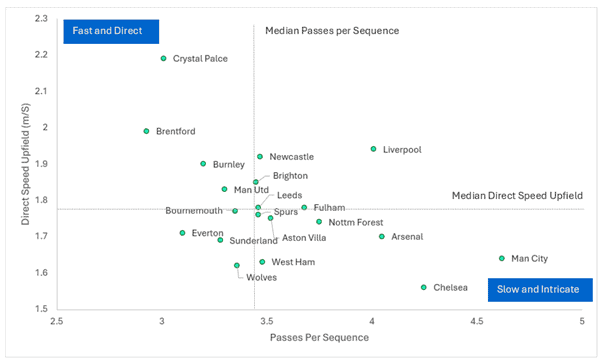
Two metrics make this plain: direct speed upfield (build‑up speed) and passes per sequence. The best versions of Howe’s Newcastle attacked quickly with few passes—fast and direct. They didn’t try to be Manchester City; they didn’t need to. But this season’s Newcastle have slipped toward the median on both axes: not fast enough to overwhelm, not intricate enough to suffocate. It’s the worst of both worlds—too ponderous to knife through teams, too imprecise to pull them apart.
Image: Graph showing the attacking style of all Premier League teams for the 25/26 season.
On the spectrum, City remain the archetype of slow, surgical control and currently sit second; Crystal Palace, far more vertical and direct, hover two points off the Champions League places. The league is rewarding clarity. Know what you are, then be the most extreme version of it you can afford.
And we’ve seen what Newcastle look like when they remember: Tottenham, 6–1, five goals in 21 minutes, football as gale‑force. That is not an accident; it’s a choice.
The recruitment question and a clear, realistic fix
So what now? The obvious answer is also the right one: return to the high press, not as a situational gambit, but as the defining behaviour. Newcastle haven’t sustained it consistently since 2023/24, and the squad has been stocked accordingly. Whatever you think of the summer window, it didn’t recruit for Guardiola‑ball. The club didn’t chase the human lock‑picks, no Cherki‑type trequartista, no Kudus‑style take‑on savant in tight corridors. Instead, the profile skewed toward pace and athleticism, Elanga, Ramsey, players who thrive in transition, who weaponise space, who turn high regains into high‑value shots.
That’s a blueprint you can work with, but only if you commit the rest of the ecosystem to it. Press high. Press often. Rotate mercilessly. The depth is better; use it like a relay team, not a comfort blanket. Some players can’t start every three days if the intensity is true; that’s the cost of clarity. But the payoff is the version of Newcastle nobody in this league wants to meet: St James’ Park shaking, the front five hunting in a pack, rest‑defence braced, second balls snapped up, and transitions hitting in waves.
If this season is a referendum on identity, then Newcastle’s path back is straightforward: specialise again. Be the side that forces mistakes 30 yards from goal. Be the team that races toward the box in three passes, not nine. The league table might look tight today, the margins forgiving. But the data and last season’s precedent warn against complacency: big swings are rare, and the middle ground is quicksand.
Do that, and Newcastle won’t need a statistical outlier to climb. They’ll simply become themselves again, loud, ruthless, unmistakable, and the table will move the way it usually does for specialists: upward, and fast.