
Before a ball was kicked at the Parc des Princes, the equation was brutally simple for Newcastle United.
Win in Paris and progression to the Champions League last 16 would be secured automatically. No February playoff. No extra two-legged gamble that could drain legs and focus. Just a clean route into the knockout rounds and confirmation that Newcastle’s return to Europe’s elite was not a fleeting adventure.
Anything less, and the margins would tighten. A draw or defeat would push Newcastle out of the top eight of the league phase and into the uncertainty of a playoff tie — still progress, but the hard way.
The problem, of course, was the opponent.
Paris Saint-Germain were not just another elite side. They were the reigning champions of Europe, comfortable on nights like this, fluent in pressure, at home in an arena built for control and intimidation. Newcastle, by contrast, were still learning how to manage these moments, how to survive them, how to shape them, how not to be swallowed by them.
And then Eddie Howe named his team.
The Team Sheet That Changed the Mood
When the lineup dropped, surprise turned quickly into concern.
A back five wasn’t a concern, it was pragmatic. Anthony Gordon on the bench. Harvey Barnes also among the substitutes. In their place, Anthony Elanga was handed a start, with Newcastle clearly prioritising structure over firepower.
The reaction from the fanbase was immediate and largely negative. This was not what many expected, or wanted, given the stakes. Newcastle needed a win, not containment. The fear was that this setup signalled caution, even acceptance, rather than belief.
It was the most uneasy pre-kickoff mood around a Newcastle European lineup in some time. But as the night unfolded, that initial judgement began to soften.
A Familiar European Punishment
The opening minutes followed a script Newcastle fans have come to recognise in Europe.
PSG dominated possession early, stretching Newcastle’s unfamiliar shape, probing for weaknesses. Newcastle sat compact, absorbing pressure, adjusting on the fly.
Then came the moment that felt almost preordained.
A ball into the box. A deflection. Lewis Miley, still a teenager learning the unforgiving nuances of elite European football, raised his arm as running. The contact was minimal, the intent questionable, but Champions League precedent is ruthless. Arm away from body. Decision made.
Penalty.
The away end was split between nerves and fury. Harsh? Yes. Surprising? Not really.
Nick Pope stood tall. The run-up came. The strike followed. Pope guessed right and produced a superb save, pushing the ball away and detonating a roar from the Newcastle support that cut through the Paris night.
Relief surged. Newcastle were still alive.
Only briefly.
PSG Strike — and Newcastle Don’t Fold
Minutes later, PSG found the breakthrough anyway. Pressure finally told, and the champions took their lead with clinical inevitability.
At 1-0, the fear was that this would unravel quickly. That the floodgates would open. That Newcastle’s European dream would be postponed by force rather than fine margins.
Instead, something changed.
After 20 minutes of sustained pressure, Newcastle began to settle. The back five stopped retreating and started stepping. Sandro Tonali dropped into pockets of control rather than emergency cover. Joe Willock’s running disrupted PSG’s midfield rhythm.
The game slowed. Newcastle breathed.
They started to find chances, not clear-cut, not abundant, but enough to remind PSG that this was not a training exercise. Newcastle were here to compete, not merely endure.
Burn Rises, Willock Finishes
Just before half-time, Newcastle found their moment.
A free kick was delivered into the box. Dan Burn rose, towering, stretching, winning the duel. His header was not aimed at goal but guided instead into the heart of danger.
Joe Willock arrived perfectly.
The contact was emphatic, a powerful header driven past the goalkeeper with conviction and belief. For a split second, the stadium fell quiet. Then the away end erupted.
1-1.
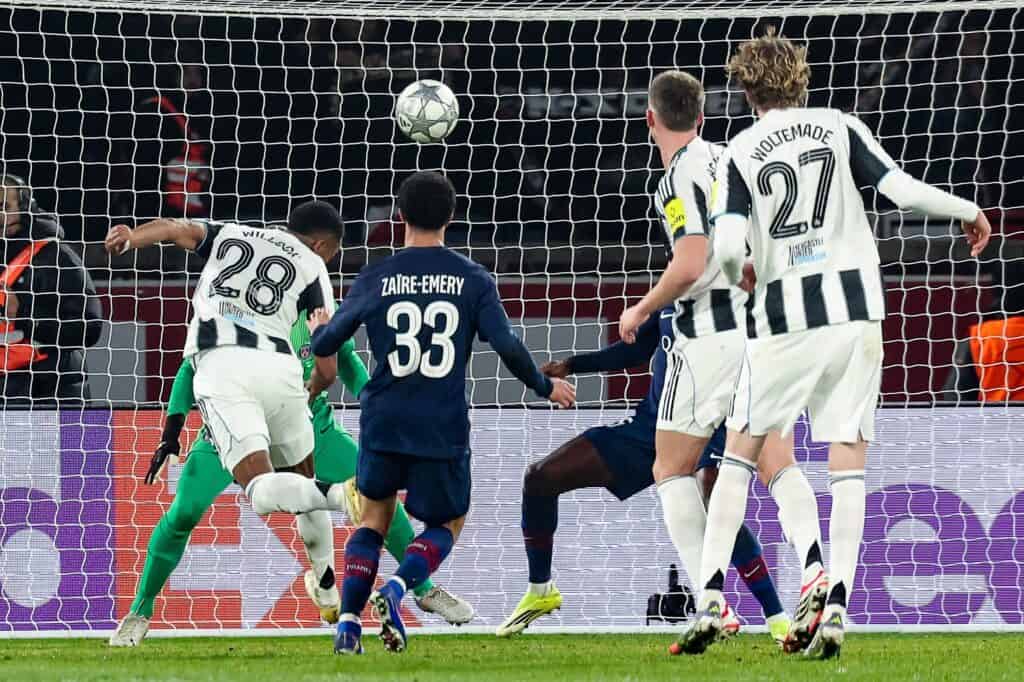
Image: Joe Willock powers his header past PSG keeper, Safonov.
At half-time, Newcastle walked off level with the champions of Europe, having weathered the storm and landed a punch of their own. The narrative had shifted completely.
A Second Half of Fine Margins
The second half unfolded in much the same way, tense, balanced, fragile.
PSG pushed without fully overwhelming. Newcastle threatened without fully committing. Chances came at both ends, but neither side found consistent clarity in the final third.
Willock thought he had struck again, bursting through and finishing confidently, only for the flag to rise almost immediately. The offside was clear, the disappointment sharp.
Eddie Howe turned to his bench. Harvey Barnes entered with intent, and almost delivered the decisive moment. Arriving at the back post, the chance fell kindly, perhaps too kindly. Barnes struck, slicing the effort onto the bar, the ball ricocheting away from goal and from Newcastle’s grasp.
Anthony Gordon also had opportunities to shift the narrative. In one key moment, rather than driving or releasing the ball, he looked for contact, hoping to win a penalty. It never came. In other situations, Newcastle’s final ball lacked precision, the decisive pass just overhit or delayed.
These were the margins. These were the moments.
The Final Whistle — And the Reality
When the whistle finally blew, the scoreboard read 1-1.
The group table confirmed the consequence. Neither PSG nor Newcastle had done enough to finish inside the top eight. Automatic qualification was gone.
Newcastle would progress, but via the playoff route. A two-legged tie against either Monaco or Qarabag awaited.
It was not the outcome Newcastle wanted. But it was not a failure either.
Not a Classic — But a Statement
This was not the Newcastle of the 4-1 demolition of PSG two seasons earlier. There was no chaos, no relentless attacking wave, no St James’ Park fury shaking Europe awake.
Instead, this was something subtler.
This was Newcastle managing a hostile environment. Adapting tactically. Absorbing pressure. Responding to setbacks. Competing, genuinely, with the very best.
In Paris. Against champions. With everything on the line.
It may not have secured the shortest route forward, but it offered something arguably just as valuable: proof that Newcastle belong here, and that their European education is accelerating fast.