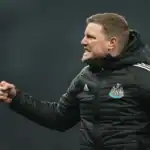
Why Eddie Howe Can’t Take Newcastle United Into Their Next Era
There is a particular kind of silence that follows a familiar disappointment. It is heavier than anger, more unsettling than outrage. You could feel it in Catalonia on March 18. You could hear it at St James’ Park when Sunderland came and took what they wanted. You could sense it again at Selhurst Park, with Newcastle ahead, time ticking down, and the ending somehow already written.
For Newcastle United supporters, this has been one of those spells where belief doesn’t so much evaporate as quietly drain away. Not because the club has no ambition, far from it, but because the gap between ambition and execution is now too wide to ignore. And in that gap, uncomfortable questions about Eddie Howe are no longer theoretical or premature. They are urgent.
This is not about denying what Howe has done. It is about recognising what he cannot do.
The last three defeats do not simply represent a bad month or a dip in form. They have illuminated, starkly and repeatedly, why Eddie Howe is not the man to lead Newcastle United 2.0 in the Saudi-backed era. Not into the deepest end of European competition. Not into the strategic, ruthless, elite world the ownership has openly targeted.
Barcelona Away: A Humbling Night In Europe
The 7–2 defeat to Barcelona on March 18, 2026 will sit in the club’s European history as one of those nights that demands context before judgement. There is, of course, no shame in losing to this Barcelona side. They are tactically sophisticated, technically devastating, and built for nights like these. Many excellent teams have gone to the Camp Nou and lost.
What made this night different was not the defeat itself, but how little it had in common with the tie Newcastle had navigated just seven days earlier.
The 1–1 draw at St James’ Park had been a triumph of discipline and planning. Newcastle limited space between the lines, disrupted Barcelona’s rhythm, and forced them wide. It was a game that suggested Howe could, on his day, prepare a side to compete at the highest level. The hope, perhaps the assumption, was that the second leg would reflect evolution, not abandonment.
Instead, it was obliteration.
Seven goals conceded in an away leg after demonstrating clear methods of containment at home is not bad luck. It is not individual error multiplied. It is a managerial failure to adapt. Once Barcelona adjusted, increasing tempo, moving midfield runners higher, isolating Newcastle’s full-backs, there was no response. No recalibration. No attempt to stem the tide. Newcastle were carved open repeatedly in the same ways, to the point that the final scoreline felt almost merciful.
Elite European football exposes managers. It demands in‑game intelligence, preventative changes, and sometimes uncomfortable concessions. Howe offered none. The game ran away from him, and he followed, hands in pockets, hope receding with every wave of Barcelona pressure.
For a club that sees itself competing regularly on this stage by the end of the decade, this mattered. A lot.
Sunderland at Home: Authority Lost
If Barcelona was about tactical ceiling, Sunderland at home was about leadership and mentality, and it was, in many ways, more damning.
This was a Sunderland side newly promoted this season. A Sunderland side struggling badly in the second half of the campaign. A Sunderland side that arrived at St James’ Park with less quality in almost every area of the pitch.
And yet Newcastle lost. Again.
The defeat itself was unacceptable. The manner of it was worse.
Newcastle took the lead and did precisely what supporters have become accustomed to seeing under Howe this season: they retreated without instruction, controlled nothing, and imposed nothing. There was no attempt to dominate possession, no aggression in pressing, no sense of inevitability that this game would end the only way it ever should have.
It was passive. Timid. Pathetic.
Derbies are about authority as much as tactics. They are about stamping your presence on a game and making sure the opponent knows, unmistakably, that this is not their place, not their moment. Newcastle did none of that. Instead, they allowed Sunderland belief, rhythm, and ultimately control.
There were mitigating factors, if you were searching for them. The midweek exertions against Barcelona. The physical and emotional toll of Europe. The sense that maybe, just maybe, this was one game too far before the international break.
And so there was a sliver of hope. Damaging as the defeat was, perhaps the three‑week pause would reset things. Perhaps time on the training ground would sharpen patterns. Perhaps key players returning would reignite something that had gone stale.
It was hope without evidence, and it did not survive Selhurst Park.
Newcastle arrived at Crystal Palace with a rested squad. Even those on international duty had enjoyed at least ten days to recover. Key players were back. The bench was strong. This was meant to be Eddie Howe’s reboot, refreshed legs, clear ideas, renewed energy.
For an hour, it almost worked.
Newcastle took the lead. They looked organised. Palace had started with a weakened side, their priorities elsewhere. This was the perfect moment to press the advantage, to score again, to kill the game.
They didn’t.
As Palace made changes, Newcastle stood still. As momentum shifted, Howe waited. As pressure mounted, the response never came. Substitutions were reactive only in the most literal sense: after the damage was done, with too little time left to affect anything.
Again, Newcastle collapsed late. Again, a lead was surrendered. Again, a winnable game slipped away.
What made this defeat particularly revealing were Howe’s own words afterwards. Asked about the alarming number of points dropped from winning positions, he said: “We haven’t been able to consolidate really good passages of the game, but go on and score more goals and continue to attack. I think I’ve said many times that’s not the tactical instruction we give the players. We don’t want to go 1–0 up and change to a mentality of defending — but we’ve done it.”
That admission cuts to the heart of the problem. Howe cannot change the flow of games, and he cannot convince his players to execute his plan consistently under pressure. Newcastle have picked up the fewest points in the league this season when conceding first. When the script changes, they do not.
At this level, that is fatal.
Patterns That Can’t Be Ignored
These three games form a coherent, troubling picture.
Howe lacks the tactical pedigree for elite European football. He has no background in it as a player or manager, and it shows when margins become microscopic and opponents unforgiving. His in‑game management is frequently late, conservative, or indecisive. Newcastle too often look like a side waiting for instructions that do not come.
There are individual examples everywhere.
Nick Woltemade, brought in as the focal point of the attack, started well. Then he was dropped. Then he was reintroduced in deeper roles that blunted his strengths. At one point, he was playing in midfield, a decision that has puzzled observers and reportedly drawn questions from the German national set‑up.
Yoane Wissa has been fit for five months and is almost invisible. Minutes are scarce, opportunities rarer still. Anthony Elanga has struggled badly to adapt, his pace rendered irrelevant by systems that do not maximise transition.
This does not feel like a squad growing together. It feels like one searching for direction.
A Club Moving Forward — Without Its Manager
Behind the scenes, the club is already changing.
Sporting director Ross Wilson and CEO David Hopkinson are steering Newcastle towards a clear, modern vision: becoming one of the world’s best teams by 2030 through intelligent player trading and the development of elite young talent. It is a long‑term strategy that demands alignment, adaptability, and a manager capable of juggling domestic ambition with European complexity.
That profile does not obviously fit Eddie Howe.
Newcastle now face a fork in the road. Either appoint an experienced elite‑level manager, someone who has proved they can balance league and continental demands, like Unai Emery or Diego Simeone, or move decisively and secure the next great coaching mind before they become unavailable. Someone like Cesc Fàbregas, whose understanding of space, tempo, and game manipulation feels tailored to the modern elite game.
What matters is that the choice matches the ambition.
The Right Ending
None of this should erase what Eddie Howe has given Newcastle United.
He arrived at a broken club and rebuilt its belief. He delivered nights and seasons that will live forever in the memory. He made Newcastle proud again. For many supporters, he presided over the best years they had ever known.
That matters.
Howe deserves a special place in the history of this football club. He should be remembered fondly, spoken of warmly, welcomed back always. But football, at its sharpest edge, is ruthless about timing.
For the next part of the journey, for Newcastle United 2, the club must be brave enough to say thank you, and then move on.
So thank you, Eddie. For the memories, the belief, the transformation.