

Newcastle United face one of their sternest tests of the season when Arsenal visit St James’ Park on Sunday, 28 September. This is a clash between two of the league’s most tactically disciplined sides, with Arsenal chasing the early pace-setters and Newcastle looking to assert themselves as genuine top-four contenders. The Gunners arrive with a reputation for control, precision, but still lacking a cutting edge in the final third.
Summer Signings
Arsenal’s summer recruitment was calculated and ambitious. Viktor Gyökeres was the headline arrival, giving Mikel Arteta a true penalty-box striker capable of running in behind and dominating aerially. Martín Zubimendi joined to provide composure and press resistance in the first phase, while Eberechi Eze added dribbling and creativity between the lines. Noni Madueke was brought in for directness on the flanks, and defensive depth came in the form of Cristhian Mosquera and Piero Hincapié. Christian Nørgaard added depth in midfield, whilst Kepa Arrizabalaga arrived as experienced cover in goal. These signings were designed to add verticality and unpredictability without compromising the defensive solidity that has underpinned Arsenal’s resurgence under Arteta.
Recent Form
Arsenal have started the season strongly, sitting near the top of the table with three wins, one draw, and one defeat from their opening five matches. They have scored ten goals and conceded only two, underlining their ability to dominate defensively. At home, they have been expansive and ruthless; away from the Emirates, they have shown a more pragmatic edge, prioritising control and risk management. This trip to Tyneside will test that balance.
Style of Play
Arteta’s Arsenal operate in a fluid 4‑3‑3 that morphs into a 3‑2‑5 in possession. The left-back, often Riccardo Calafiori, steps inside to form a double pivot alongside Zubimendi or Rice, creating a box midfield that secures central zones and facilitates progression. This structure allows Arsenal to occupy all attacking lanes, stretching opponents horizontally while maintaining overloads in midfield. The trade-off is that when the left-back inverts, the far-side channel can be exposed if the counter-press is not immediate, enter, Anthony Elanga.
Out of possession, Arsenal press aggressively in a 4‑4‑2 shape, with Gyökeres and Ødegaard leading the line of engagement. Their pressing traps are designed to funnel play wide, where they can spring on loose touches. Behind the press, Saliba and Gabriel hold an aggressive line, trusting their pace and timing to defend large spaces. This high-risk, high-reward approach has made Arsenal one of the most suffocating teams in Europe when it works, but it leaves them vulnerable to direct play if the first press is broken.
In the final third, Arsenal’s right side remains their most potent weapon. The triangle of Timber, Ødegaard, and Saka creates constant overloads, with rotations that open lanes for cut-backs or inside shots. Gyökeres’ presence has added a new dimension: a consistent target for crosses and a threat in behind, something Arsenal lacked when relying on false-nine systems in previous seasons.
Team News
Bukayo Saka is expected to start after returning from a minor knock, while Martin Ødegaard is pushing for inclusion after resuming full training. Noni Madueke is sidelined with a knee injury and will miss several weeks, while Kai Havertz and Gabriel Jesus remain out with long-term knee issues. Piero Hincapié is a slight doubt with a groin problem, but the core of Arsenal’s first-choice XI should be available.
Where They Can Hurt Newcastle
Arsenal’s primary weapon is their right flank. Saka’s ability to isolate defenders and attack on his stronger left foot is well documented, but what makes this side even more dangerous is the interplay with Ødegaard. The Norwegian drifts into the right half-space, creating passing triangles that allow Arsenal to progress cleanly and then overload the edge of the box. If Newcastle’s left-back is drawn too narrow to track Ødegaard, Saka will have room to drive at goal; if he stays wide, Ødegaard can dictate play centrally.
The addition of Gyökeres gives Arsenal a genuine penalty-box striker who thrives on early crosses and diagonal balls. Against a Newcastle defence that likes to hold a high line, his ability to time runs beyond the last man could be decisive. He also provides a focal point for direct play when Arsenal want to bypass pressure, something they lacked in previous seasons.
Another area of strength is Arsenal’s midfield control. With Zubimendi anchoring, Declan Rice is free to push higher and attack second balls, often arriving late on the edge of the box. This dynamic makes Arsenal extremely difficult to pin back because they can recycle possession and sustain pressure for long periods. Finally, set-pieces remain a major weapon. Under Nicolas Jover, Arsenal have become one of Europe’s most dangerous teams from dead balls, using intricate routines and physical dominance to create high-quality chances from corners and wide free-kicks.
Where They Are Vulnerable
For all their control, Arsenal’s structure leaves exploitable spaces. The most obvious is the channel behind the inverting left-back. When Calafiori steps inside, the far-side winger is often left with a huge recovery run if possession is lost. Newcastle can target this by playing early, direct passes into Anthony Gordon or Jacob Murphy, forcing Arsenal’s centre-backs to defend wide and opening gaps for late runners.
The high defensive line is another risk. Arsenal back themselves to squeeze the pitch, but if Newcastle can break the first press and release a runner early, there is space to exploit. Quick diagonals into Isak or Gordon could create one-on-one situations, especially if the timing of the run catches Saliba and Gabriel stepping up.
Finally, Arsenal’s right-sided dominance can be a double-edged sword. When they overload that flank, they commit numbers forward, leaving themselves vulnerable to quick switches of play. If Newcastle can win the ball and transition rapidly to the opposite wing, they can attack into space before Arsenal’s rest defence resets. This requires precision and bravery, but it is one of the few ways to disrupt their rhythm.
In the 1-1 draw with Manchester City last weekend, Haaland’s early goal provided the blue print for how to catch this Arsenal side in transition.
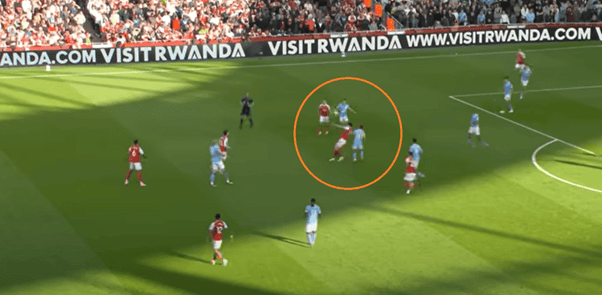
Arsenal lose possession high up the field, allowing City to attack the exposed defence.
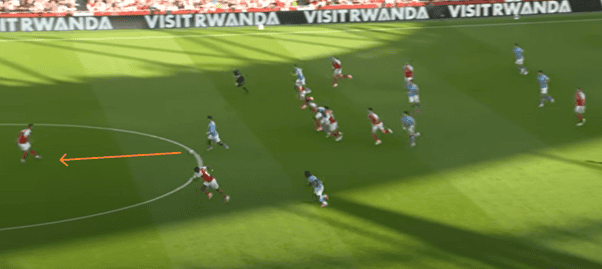
Reijnders drives forward with the ball, as the Arsenal defenders back off him.
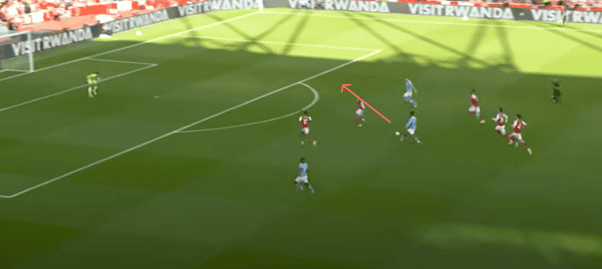
Haaland makes an excellent supporting run to the right of Reijnders, with Doku to the left, not allowing the Arsenal defenders to commit fully one way of the other.
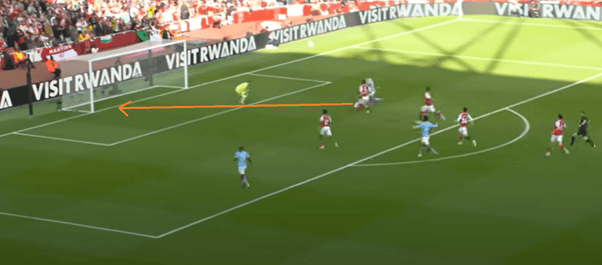
Reijnders finds Haaland with a well times pass, letting him take the ball in his stride and fire low past Raya in the Arsenal goal.
With the pace of Elanga and Gordon, and the technical craft of players like Bruno and Woltemade, this could be an area Newcastle can get some joy in against Arsenal. Chances will be limited, as Arsenal are very good defensively, so any opportunity must be taken.
Fan Comment
“Unfortunately Gordon’s back from suspension. This isn’t going to be an exciting watch. Both teams know exactly what to expect from each either and neither will shirk a physical contest. I expect the ref to have a big role in this.”
“We haven’t scored a goal in our last three visits to SJP – pretty diabolical. A lot of the reason is that Arteta has valued physical solidity over technical excellence when going there. The last time we picked a more technical team was 22/23 when we started with Jorginho, Ødegaard, Xhaka MF and we won 2-0. If we line up with Rice-Merino again we will be lucky to get anything from this game.”
“This is the perfect time to banish the demons of SJP. We never, ever do well there. We know what to expect, their crowd will be up for it as usual and their team will follow suit like against Liverpool. But it’s 11 v 11 and if we go at them we win. But, we have Arteta. There is the issue.”
“I hate this fixture, we have a mental block there. 4-0 up at HT in 2011 and we still imploded after that Tiote screamer (RIP). I’ll take a scrappy 3 points all day long. Don’t even care how.”
“It’s got 1-0 written all over it, I’ve no idea whether it’s to us or to them. Expecting the ball to be in play for about 50 minutes out of the 90.”
“They just bad matchup for us. One of the few teams who has physical advantage on us and we just don’t have enough guile to play through them. Burns seem to have it so easy against us every time just heading balls away.”
“I hope Lewis Skelly plays instead of Calafiori. Elanga will tear Calafiori a new one.”
“We won’t beat Newcastle. I’ve seen nothing so far this season to suggest Arsenal will get all three points. Very disappointing start to the season. We’ve beaten the teams we should be beating, fumbling at Anfield and not putting City to the sword. To much boredom football and simply not enough of going full speed on teams add to this more injuries it’s not looking like progress to me.”
“Always a massive atmosphere, Sunday 4.30, theyre all going to have been on the beer, it will be loud again.”
The Key Question: Fire or Ice?
This game could hinge on Arsenal’s response to Newcastle’s physical edge. If they try to fight fire with fire, they risk losing their identity and playing into Newcastle’s hands. If they stick to their principles, they must be brave enough to keep playing under pressure, even when the crowd roars and tackles fly in. Control versus chaos — that’s the real battle at St James’ Park.